
It was a little past 9 p.m. on a frigid December evening. Greggy Sorio walked past row after row of passengers as two U.S. Immigration and Customs Enforcement (ICE) agents escorted him to the back of the airplane. When he took his seat, he did something he had not allowed himself to do throughout the ten months he’d been detained at the Northwest ICE Processing Center (NWIPC) in Tacoma, Washington: He let defeat sink in.
“My American dream was done, they took it away from me,” he tells The Progressive. “I felt like my fight was over—I’d lost everything.”
As he settled into his seat on the plane, Sorio, a thirty-seven-year-old with a stern expression, felt his face become wet with tears. Beyond the emotional despair, his body had become a minefield of unpredictable pain, and a fourteen-hour flight from Tacoma to the Philippines had the potential to be excruciating. Since being transferred to NWIPC in March 2025, Sorio had developed ulcerative colitis, an intestinal disorder that frequently left him screaming from severe abdominal pain. The detention center’s medical staff refused to treat him, allowing his illness to progress until he developed a bone infection so severe that his pinky toe had to be amputated in October 2025.
While counting down the minutes before his plane was set to take off, he thought about his daughter in Alaska. He didn’t know if he would ever see her again. In just a few minutes, the plane would be leaving for the Philippines, where Sorio would be stranded in a country where he had not lived for nearly twenty years.
In the departure terminal, as Sorio waited in his seat on the back of the airplane, a group of around three dozen members of Tanggol Migrante, a Filipino-led alliance of grassroots organizations that later combined into a united movement in response to the Trump Administration’s attacks on migrant workers, called for Sorio’s freedom. To them, Greggy Sorio was known as “Kuya G,” from the Tagalog word for brother. Sorio didn’t realize it at the time, but he was about to be at the center of an informal coalition of rank-and-file union members and immigrant rights activists that had spent the better part of a year growing stronger, more sophisticated, and ready to respond to crises at a moment’s notice.
At 10:30 p.m. on December 7, 2025, the plane lifted off the tarmac of the Seattle-Tacoma International Airport (SEA-TAC). Sorio did not leave with it.
Sorio had entered the United States as a lawful permanent resident in 2007, when he was still a teenager, with the hope of escaping the poverty that dominated his childhood in the Philippines. He quickly found employment in Kodiak, Alaska, at a cannery, where the work was underpaid, unforgiving, and often dangerous. Still, Sorio found himself surrounded by a dense Filipino immigrant community, bound together by the shared experience of having escaped unlivable conditions only to be met with a constant uphill battle in the United States.
From the time he arrived in the United States to the moment in early March 2025 when ICE shuttled him hundreds of miles away to a group cell inside of NWIPC, Sorio had never left Alaska. He knew no one. At the time of his detention, he was a permanent U.S. resident, and had a young daughter living in Kodiak.
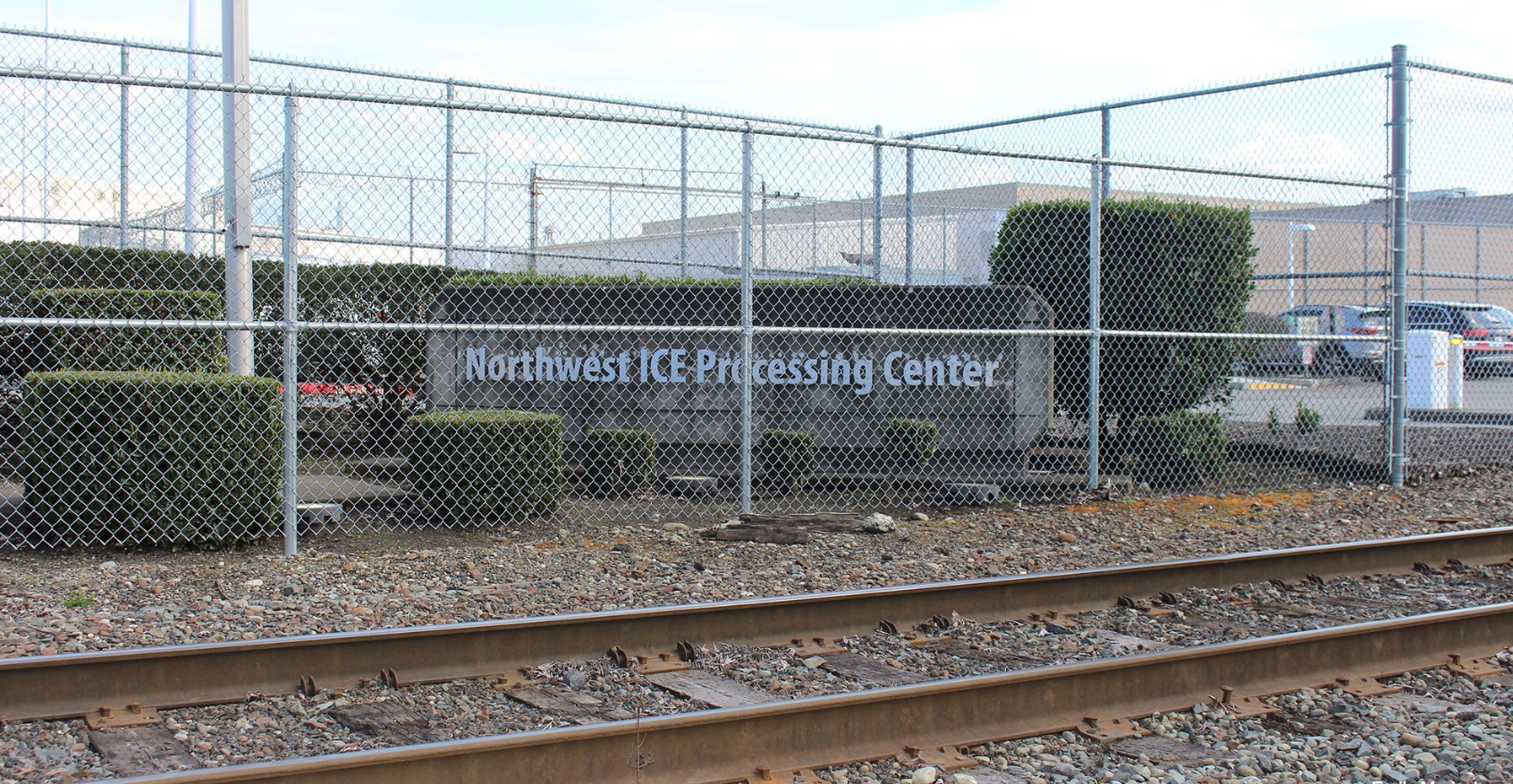
NWIPC is tucked into a corner of a nondescript industrial hub in Tacoma. Outside of the facility, a long stretch of chain link fence runs parallel to train tracks that fade into a distant thicket of pine trees. On the other side of the fence, two poles loom overhead: One flies the American flag and the other flies the flag of Washington State, and beneath it, a flag displaying the GEO Group logo in big blue letters.

Emily Markwiese
The Northwest ICE Processing Center (NWIPC) in Tacoma, Washington, where Greggy Sorio was detained for eleven months.
While NWIPC serves as a processing center for ICE, it is managed and operated by the GEO Group, a private, for-profit prison company. GEO’s website states that its ICE processing centers “have a long-standing record providing high-quality, culturally responsive services in safe, secure, and humane environments that meet the needs of the individuals in the care and custody of federal immigration authorities.” But Josefina Mora-Cheung of La Resistencia, a local grassroots organization that has been calling for the permanent closure of NWIPC (formerly known as Northwest Detention Center) since 2014, says this description reads like fiction. “It’s like a sci-fi movie in which there’s a villain group attempting to hide all of the human rights abuses happening behind its doors,” she tells The Progressive.
Mora-Cheung explains that like all privately run ICE detention centers, NWIPC lacks any kind of meaningful oversight or accountability structure. When detainees report abuse or neglect, ICE conducts the investigation. Twenty-nine people have died while in ICE custody since October 2025, a historic high. At NWIPC, three people have died since 2018; in the past few months, La Resistencia has supported eleven hunger strikes in response to inhumane conditions, including severe medical neglect.
In February 2026, The New York Times published an investigation into medical negligence at ICE facilities run by private contractors across the country, finding detainees were refused life-saving medication, waited weeks to be seen for serious ailments, and were regularly exposed to unsanitary living conditions. In response, the U.S. Department of Homeland Security (DHS) issued a statement denying the Times reporting. The statement quoted the DHS Chief Medical Officer, Sean Conley, who declared, “This is better, more responsive health care than many aliens have ever received in their entire lives.” Even by the grim standard of care in the U.S. medical system outside of ICE detention, there is virtually no evidence to support this claim; it certainly was not the case for Sorio.
Troy Osaki and Noah Atejo, two members of Tanggol Migrante who would go on to play pivotal roles in Sorio’s detention fight, first met Sorio in May 2025 while organizing in support of two Filipino immigrants, Maximo Londonio and Lewelynn Dixon, who were also detained at NWIPC. “We were able to introduce ourselves,” says Osaki. “Greggy wanted to learn about us and what we were doing. We pretty much immediately started making visits to him on the regular.”

Emily Markwiese
From left to right, Noah Atejo, Greggy Sorio, and Jo Faralan at the popular Filipino supermarket Seafood City in South Seattle.
Sorio quickly became a friend and a cherished member of the Tanggol Migrante community. Around the beginning of summer, Osaki says, Sorio began experiencing extreme pain in his abdomen. The pair was alarmed to see visible signs of Sorio’s health declining. Along with the pain, Sorio reported seeing blood in his stool to staff from the ICE Health Services Corps (IHSC), which is responsible for providing medical care at NWIPC. Each time he was seen for an appointment, IHSC staff sent him away with laxatives or fiber supplements, and instructed him to watch his diet—a near-impossible task given that detainees have no control of their food supply. Sorio tells The Progressive that he and his cellmates were regularly served raw meat, which they had to microwave for twenty or thirty minutes at a time to cook through.
“They could see how much pain I was in,” says Sorio. “They didn’t care, they didn’t try to help me. It was heartless.”
In early October, months after his initial symptoms began, Sorio was in so much pain he could barely walk. Doubled over, he begged to be taken to the hospital, but was denied and given ibuprofen instead. After several more hours of crying in agony, IHSC staff relented and transported Sorio to the emergency room, where he was prescribed antibiotics. When he returned to NWIPC and asked for his prescription, IHSC staff refused to give it to him, insisting he had a condition that didn’t require antibiotics.
By late October, Sorio’s pain had worsened, and he’d noticed swelling in his foot. He was again taken to the emergency room. He spent twenty-two days in the hospital, where he was diagnosed with ulcerative colitis, severe vitamin D deficiency, and kidney disease. The swelling in his foot had been caused by a bone infection which had escalated from the compounding stress on his immune system, to the point that his toe had to be amputated. Medical staff at the hospital attributed Sorio’s condition to the months of improper treatment he received while in detention at NWIPC. Had Sorio been given antibiotics the first time he reported extreme abdominal pain and blood in his stool, his pain would have stopped within the first few days of taking medication, and his ulcerative colitis would have been treated long before the point at which he developed the bone infection.
Despite his frail medical state, Sorio returned to NWIPC from the hospital in November 2025, ready as ever to advocate for himself and his fellow detainees. “He has a goofy side, but he is a true leader,” Atejo says. Sorio would make a point to introduce himself to every recently detained Filipino immigrant in his cell, Atejo recalls, to connect them with someone from Tanggol Migrante. In one case, he says, Sorio was able to convince a despairing cellmate who had planned to self-deport that he should stay and not give up hope on his asylum case. As the months passed, and other detainees came and went, he held on to his fighter’s spirit. Then, on the morning of December 7, Sorio was informed by a DHS officer that he would be getting put on the next deportation flight back to the Philippines.
“We did a kampuhan, a camp-out in our cars at the detention center the night before and morning of his flight,” says Keri Panlasigui, who is part of a Tanggol Migrante member organization called Malaya Tacoma. “When we saw that gray car with Greggy inside of it drive out of the parking lot, people were chanting, people started crying. We thought that the battle was lost.”
Back in May 2025, as Sorio was trying to make sense of his imprisonment and before he had started to experience his first signs of medical trouble, the Washington state labor movement had been embroiled in a fight to free Maximo Londonio and Lewelynn Dixon from NWIPC. In early May, Londonio—a forklift driver, father of three, and International Association of Machinists and Aerospace Workers (IAM) Local 695 member nicknamed “Kuya Max”—was arrested by ICE and imprisoned at NWIPC after coming home from a trip to visit family in the Philippines. Less than two weeks later, Dixon—a University of Washington lab technician and Service Employees International Union (SEIU) Local 925 member affectionately known by her coworkers and fellow union members as “Auntie Lynne”—was apprehended and taken to NWIPC by ICE agents. Like Sorio, Londonio and Dixon are both legal permanent residents of the United States.
The local labor community’s response to Londonio and Dixon’s detainment was swift. Both IAM and SEIU immediately jumped into action: They held press conferences, secured legal aid, called elected officials, mobilized members for rallies, and created public fundraisers to support Londonio and Dixon. For weeks, large crowds of union members, immigrant rights activists, community members, and Londonio and Dixon’s loved ones swarmed outside of the chain link fence around NWIPC, demanding their release. Osaki and Atejo were at every one of those protests. “The fight to free Kuya Max and Auntie Lynne really showed us that everyone plays a part,” Osaki says. “Grassroots organizations, unions, faith leaders, students—everyone.”
The most powerful of these demonstrations, Atejo says, were those which involved the local labor community working in coalition with other groups. Atejo describes how both IAM and SEIU would show up to rallies with coordinated signs displaying Londonio and Dixon’s names and faces, chanting calls for their release. Dozens of union members had been mobilized to turn out for their union siblings by the leadership of their locals. IAM brought their International President to the picket line at NWIPC—which Atejo says speaks to how serious the entire union was about committing every possible resource to demanding the release of their member.
“Unions just have this aspect of legitimacy behind them,” he says. “They’re established, connected to different industries, and have an ability to garner funds and political pressure that grassroots organizations can struggle with but really benefit from. And to me, there was nothing more powerful than the rank-and-file workers taking political stands. The biggest rallies we had for Max and Auntie Lynne were the ones we held with union members. That show of strength, that’s what makes a difference.”
After weeks of sustained public pressure, Dixon and Londonio were released and reunited with their loved ones in May and July 2025, respectively. The pressure campaign for their release was over, but the months of protests had fostered organizing relationships between members of Tanggol Migrante and members of Londonio’s and Dixon’s unions—relationships that soon proved to be enduring. Brandon Johnson, an Alaska Airlines gate agent and IAM Local 2022 member, first met Osaki and Atejo at a protest calling for the release of Londonio, his union brother. He had a personal connection to Dixon as well—his wife was a fellow member of her SEIU local. Through Osaki and Atejo, Johnson became connected to the larger Tanggol Migrante movement.
Then, late in the morning on December 7, he was standing outside a poke restaurant waiting for his wife when he got a text—Sorio was about to be deported on a Philippine Airlines flight out of SEA-TAC, where Johnson worked. Johnson happened to be traveling out of state at the time, but he immediately called his coworker and fellow IAM member, Evan Church, to float an idea.

Emily Markwiese
Brandon Johnson and Evan Church in Seattle's Columbia City neighborhood.
“It’s a huge liability for an airline to fly a passenger who is that sick on a commercial flight,” Church tells The Progressive. Johnson and Church knew there were already dozens of Tanggol Migrante members heading to the airport to protest Sorio’s deportation. The plan took shape. Johnson would run interference from afar; Church would provide instructions on the ground; two Tanggol Migrante members would speak directly to airline staff at the check-in counter, while other members were directed to call Philippine Airlines customer service agents. With Church’s guidance on what to say and who to talk to, Jo Faralan, one of the two Tanggol Migrante activists at the check in counter, alerted Philippine Airlines staff that one of their flights set to depart later in the evening had a passenger who was a medical liability scheduled to fly on it. She was equipped with testimony from Greggy’s medical providers from his latest hospital visits, detailing his sensitive medical state and his high chance of developing blood clots—a condition that could become lethal thousands of feet in the air.

Emily Markwiese
Members of Tanggol Migrante protest Greggy Sorio's scheduled deportation outside of the Northwest ICE Processing Center in Tacoma.
Faralan and her fellow Tanggol Migrante members began speaking with airport staff at 3:00 p.m., and spent the next seven hours in back and forth communication, as Sorio’s flight drew closer to departure with each passing minute. Meanwhile, the dozens of Tanggol Migrante members gathered outside of the airport continued their protest, calling for Sorio’s release from the airplane and from detention entirely.
Faralan was eventually directed to the lead of the fourteen-person Philippine Airlines flight crew, who escalated the information about Sorio’s condition to the pilot and co-pilot of the flight. The pilots told the flight crew lead that they would refer to the Philippine Airlines medical crew for a final decision. Sorio’s plane had been grounded for an hour when the medical crew made the call: Sorio had to be removed from the plane.
Sorio doesn’t belong to a union, but Church says he still felt it was their duty as union members to intervene on his behalf. “Well, we’re all workers,” he said in late March 2026 while seated beside Johnson outside of a taqueria in Seattle’s Columbia City, the neighborhood where they both live. “These aren’t just things happening on TV. They’re happening at SEA-TAC, at our work. It’s our home, man, and we can do something about it. We have to do something about it.”
Johnson nods in agreement. “If we’re not taking care of our neighbors, then who is going to take care of us?”
Five minutes after the pilot announced the plane would be departing soon, after being grounded for an hour, a Philippine Airlines crew member told Sorio to get out of his seat and follow them off of the airplane; he would not be allowed to fly in his current medical state. “I mean, I was happy, so happy, when they said that I need to get out of the plane,” Sorio says. “I thought maybe God has a better plan for me, you know? Maybe my fight’s not over yet.”
“When he got pulled off the flight, even the Philippine Airlines staff were smiling and clapping,” says Atejo. “That was really all of us working together. All of us. Union members, grassroots, the airline staff that were there that day, but especially Greggy. The people who are the heart of the Tanggol movement are the people who are detained, who have been detained.”
After his successfully halted deportation flight, Sorio was returned back to NWIPC. Shortly after, an attorney from the Tanggol Migrante network filed a habeas petition on Sorio’s behalf, asserting that the extreme medical negligence he’d experienced in ICE detention amounted to a violation of his Constitutional rights. On February 13, 2026, a district judge granted Sorio the petition of habeas corpus and ordered him to be released from NWIPC the next day, February 14—coincidentally, the day of Tanggol Migrante’s one-year anniversary celebration in Washington.
Sorio left the detention center and went straight to the celebration. He felt he had been called, he says, to help free his fellow NWIPC detainees who were still trapped inside. “My dream now is just to stay here in the United States and to take care of my daughter, to give myself another chance and help the people who are going through what I went through,” he says.
As he walked off the plane at SEA-TAC, he says, he knew it had not been a stroke of luck or an accident that had stopped his deportation. “There was a group of people out there who did that,” he says. “It was them.”
Tags
Dispatches Immigration ICE Trump Administration
Emily Markwiese
Emily Markwiese is an independent journalist and organizer based in Dallas, Texas.
