
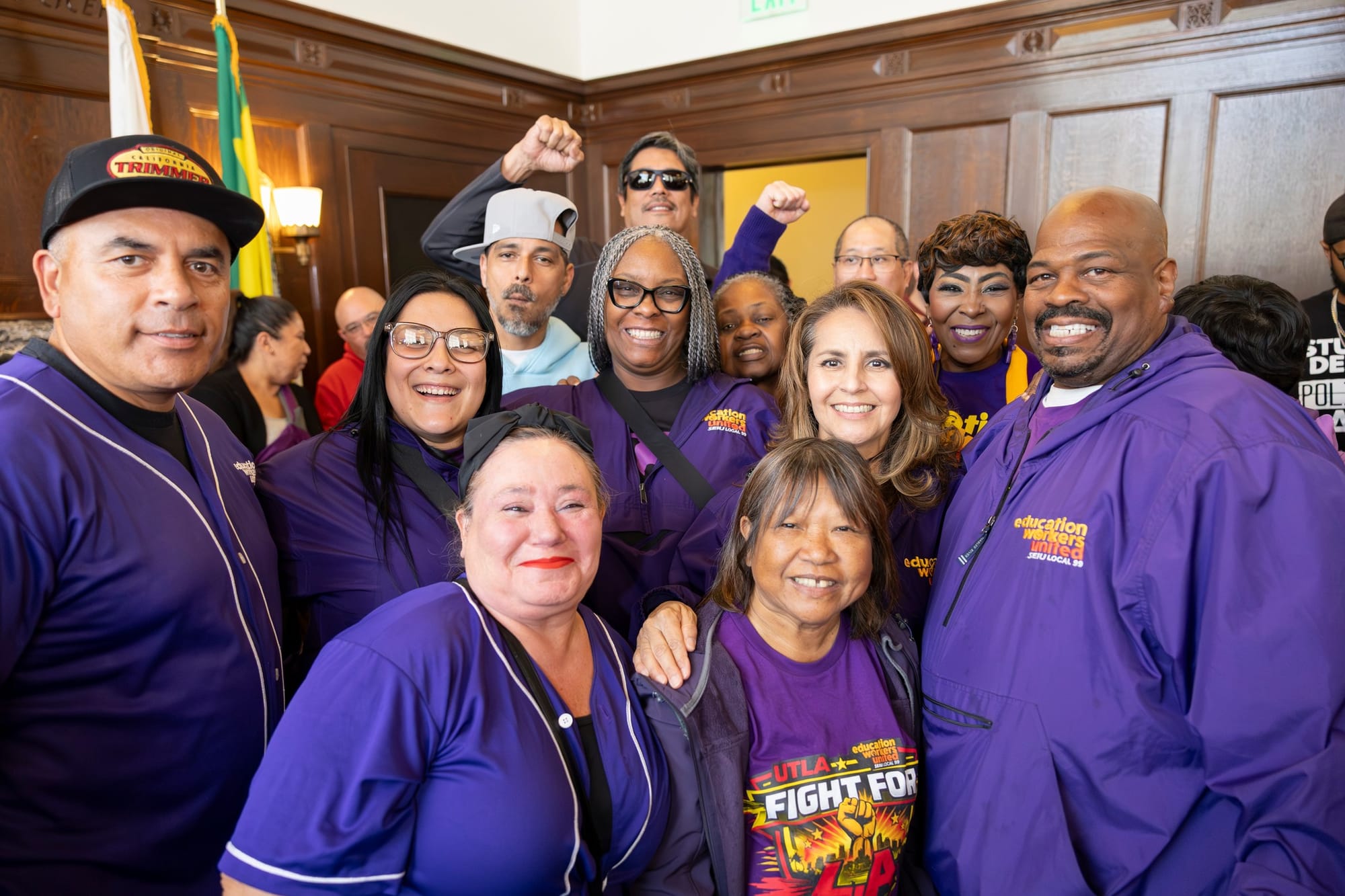
LOS ANGELES, CA - On Monday evening, I watched as Los Angeles Mayor Karen Bass paced nervously back and forth outside the conference room of SEIU Local 99. Bass had been called in by the LA United School District (LAUSD) to negotiate an agreement hours away from an imminent strike of more than 30,000 school employees, backed by as many as 50,000 teachers and administrators who were ready to strike in solidarity.
Both the teachers' union and the school administrators’ union reached tentative agreements earlier in the week, but SEIU 99, which represents low-wage cafeteria workers, janitors, and other school employees, many of whom live in poverty, was holding out for better hours and protection from layoffs.
With the strike deadline less than 12 hours away, picket signs, flyers, stickers, and sign-up sheets filled tables in the hallways.
The strike threatened to become a political crisis for Bass, who faces a tough re-election for Mayor in just two months. Bass had a look of fear on her face as it was clear that the union was determined to strike.
For more than two years, SEIU Local 99 had been working without a union contract, hoping to coordinate its contract with the teachers’ and school administrators' unions to apply joint pressure on LAUSD. Now, after both unions had settled, Bass sat late Friday afternoon in the conference room of SEIU 99, moved to tears by the stories of low-wage school employees who were just struggling to survive.
"She was really shaken by a lot of the stories," says SEIU Local 99 President Coronado Guerrero, who works as an HVAC technician for the school district.
In the meeting with Bass, with more than two dozen rank-and-file members present, rank-and-file union leaders repeatedly called out LAUSD for refusing to dip into its $5 billion reserve fund, a move that budget technocrats feared could affect their credit rating.
Despite the union's and Bass's efforts, LAUSD school board members wouldn’t budge, and many thought a strike was imminent. Around 8 p.m., I asked a union member if it was best to go home to rest to get up at 4 a.m/ to cover the first picket lines at the Van Nuys school bus depot.
“The strike is definitely on. The school board isn’t budging at all,” a top union staffer told me. So, I went back to a friend's house and tried to get some sleep.
Around 2 a.m., I woke up to texts from union staffers that a deal had been reached. The strike was called off a mere three hours before it was set to begin. LAUSD agreed to a landmark three-year contract granting workers a 24% pay raise over three years and, most importantly, a minimum of four hours per day for school employees, protection from layoffs, and guaranteed rights to healthcare benefits.
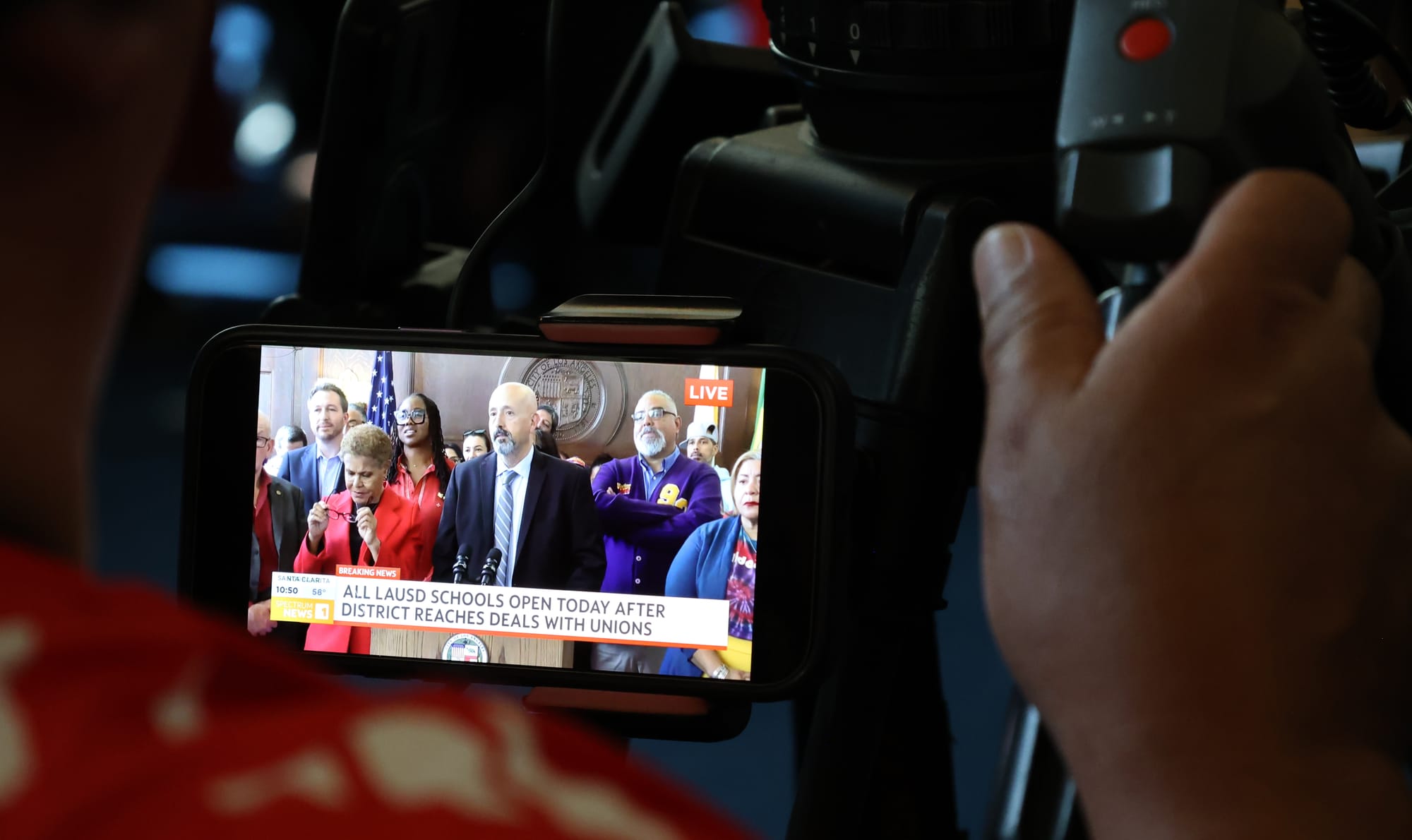
The $400 million needed for the contract would come primarily from the school district’s $5 billion reserve fund. In order to keep more reserves intact, the school district pledged to identify ways to trim down the $1 billion in work done by private contractors, moving that work in-house, and seeking additional funds from the state.
Overnight, the district’s tune had changed, which used to be “We don’t have the money, wait two years to the next contract.”
“We kept shaking the tree, and hundreds of millions of dollars fell out,” said Lester Garcia, Political Director for SEIU 99.
Over the last decade, the union educated its members that the school district had the money but just didn’t want to pay. In March of 2023, SEIU 99 went out on a three-day strike, making it clear to LAUSD that they were willing to go on strike again. The results of militancy over the last decade have changed many members' lives.
“In the last nine years, there has been over 62-63% wage increase, but only because they were willing to strike and (show) power,” says Max Arias, SEIU 99’s Executive Director (an elected position within the local).
However, for years, they won wage increases only to see the school district reduce their part-time workforce. This contract finally guarantees hours for part-time workers for the first time, preventing a strike that would have been a political disaster for a Mayor facing re-election.
On Tuesday morning, union leaders from all three unions, teachers, administrators, and staff, gathered at City Hall with school board members and Mayor Bass to celebrate the tentative agreement.
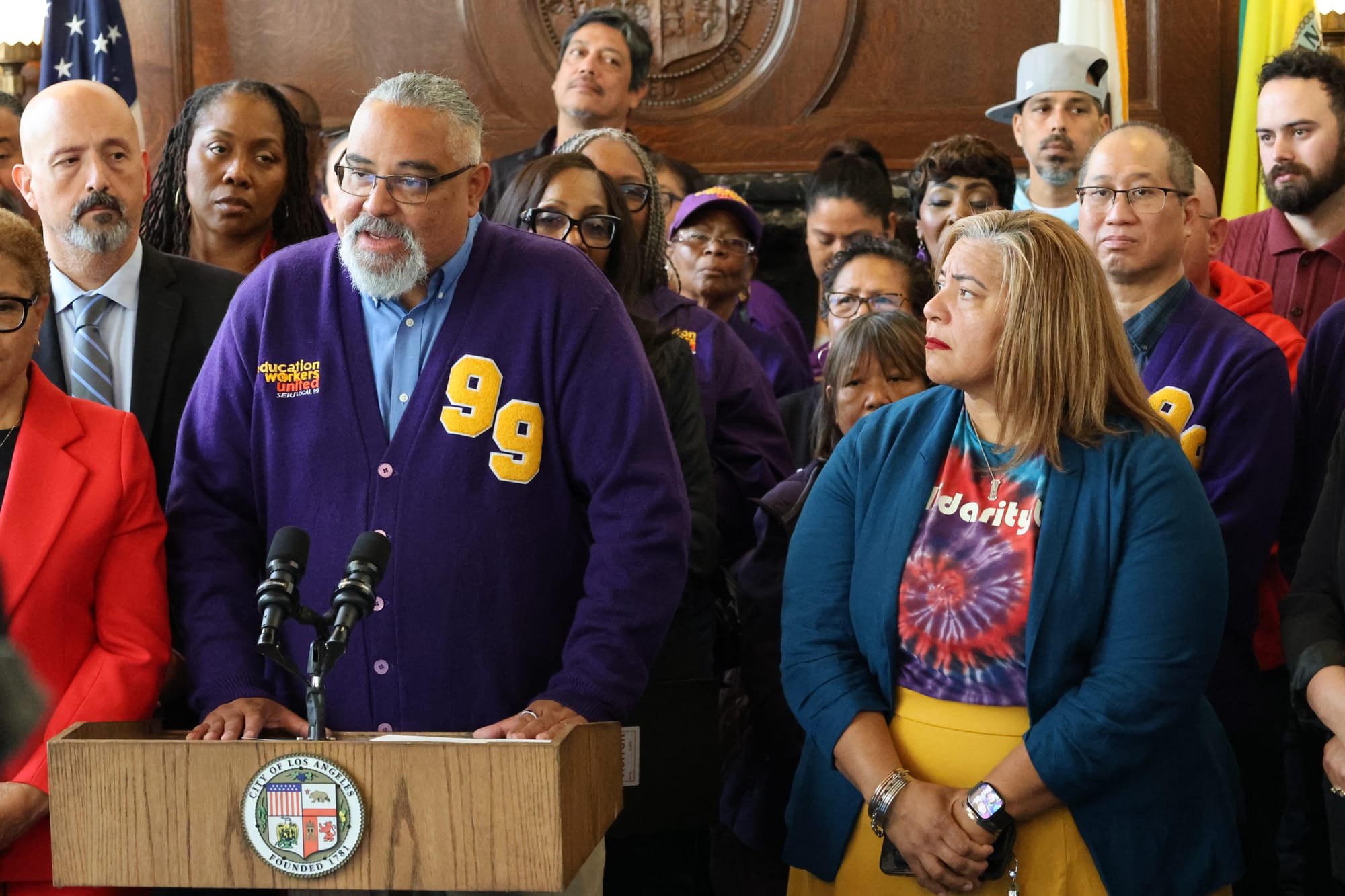
“The reality is the Mayor came in right. She came in committed to making sure that we were going to reach an agreement and she heard our stories,” says SEIU 99 President Conrado Guerrero, a rank-and-file union leader, whose regular job is working on roofs, fixing HVAC units at the 800 campuses operated by LAUSD.
Guerrero credits Mayor Bass's repeated visits to the union hall the day before the strike with helping the school board understand how serious the rank-and-file union leaders of SEIU Local 99 were about striking.
“I think our rank and file leaders are very important, just because, like myself, I could be here today, and [tomorrow] I'll be back at work up on a roof somewhere,” says Guerrero. ”I switch hats very easily, to make sure that the work that we need to do here is also being taken care of. Because I'm out on the field, I see what happens firsthand, so I can bring that to the tables where we're at.”
Guerrero also credits the pledges of solidarity from both the teachers’ union and the administrators’ union to respect their picket line if SEIU 99 went out on strike.
In previous bargaining, the school district had pit teachers and school employees against administrators. However, in December of 2024, school administrators unionized with Teamsters Local 2010. Now, the administrators found themselves coordinating bargaining strategies alongside the employees.
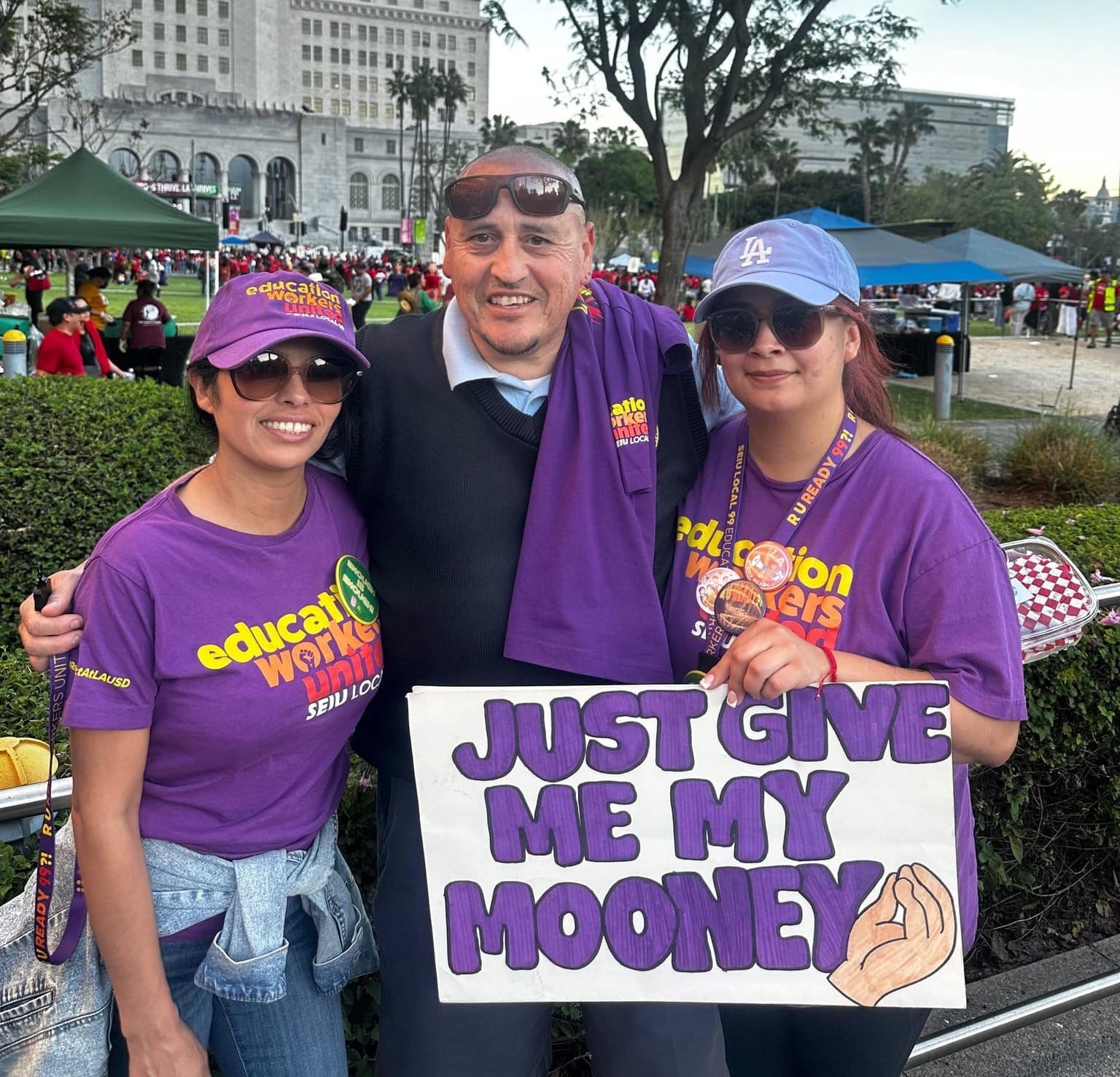
“We are strong. We have the same causes, and we are building LAUSD in a way that has never been done,” says administrators' union president, Maria Nichols.
“The solidarity of the teachers and the principals and administrators standing with us, I think, helped the district feel the pressure of not reaching an agreement with us at the table,” says Guerrero. “They're also part of the labor movement now….that didn't happen before, exactly. So now they're on the same table as us.”
SEIU Local 99 leaders also credit their victory to efforts to democratize unions, being more transparent with members, and a massive member-to-member education campaign.
“If you don't make public how bargaining is going, making them understand what we're doing, what the fight is, then it's hard for them to make any movement out on the field,” says Guerrero. “After every meeting we had, we would make a video, put out notice posts of what was happening, so the members knew where we were at every step.”
SEIU Local 99 Executive Director Max Arias decided that the union would take a different approach to bargaining. The union decided to set a firm benchmark of what their members would need to achieve a living wage.
“What traditional labor does is compare the positions of unions working with equivalent positions. So we stopped doing that. We compare the cost of living,” says Arias.
“We are not debating within their own budget, because they can manipulate the budget. So we don't engage in, you know, where we find 6 million here, those little things, because it's manipulatable like the $5 billion that they have, they don't talk about it,” says Arias.
The union gained power as members became convinced that the school district had the money in its reserve fund to pay them.
“Once you do that, you have a powerful strike. You can't budge, because you really engage the membership. That's it. The membership knew what they were fighting for,” says Arias. “It's important for workers to have clarity. In this type of bargaining, sitting at a table endlessly with a boss manipulating numbers over the same amount of money, which is what [happens] at a lot of bargaining.”
On Tuesday morning, members of SEIU Local 99 celebrated their victory. They called the school district's bluff, and they won.
“Our power, where our members are starting to learn, our power and victories, like today, is what makes them keep going forward,” says SEIU Local 99 President Conrado Guerrero. “I just want to let the workers know that the power that we do [build] out on the field reflects here at the table.”
