
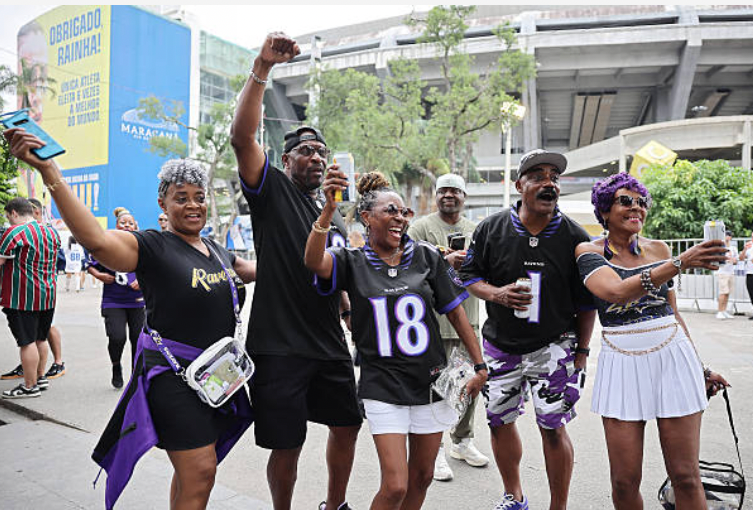
RIO DE JANEIRO, BRASIL - Yesterday, as a lifelong Steelers fan, I did something I never imagined doing: rooting for the Baltimore Ravens in the NFL’s first-ever football game in Rio de Janeiro. It was hard not to cheer for the Ravens. Thousands of Black Ravens fans made the nine-hour flight down from Baltimore, which is 60% Black, and brought some serious Baltimore energy with them.
At Rio’s historic Maracanã Stadium, the Ravens fans got the crowd of 72,000 repeatedly chanting “Defense, Defense, Defense” as the Ravens battled the Dallas Cowboys in one of the most intense football games I have ever seen, winning on a field goal with only 1 second left on the clock.
Many Baltimore Ravens fans, primarily Black fans, took advantage of cheap $500-600 flights from Baltimore-Washington International Thurgood Marshall Airport to come down and cheer on their fans. They found that Brazilians welcomed the African American fans
“Everyone has just been so great and welcoming,” one Black Ravens fan told me. “I am definitely coming back. I love Rio.”
The African American Ravens fans are part of a growing trend of African Americans coming to Brasil. Compared to Europe, where African Americans are often treated poorly, they find Brasil, where 56% of the country identifies as Afro-Brazilian, to be both accommodating and affordable.
According to a study by the Brazilian government, revenue for Afroturism companies in Brasil has increased by 400% between 2023 and 2025. Now, more than 43 groups offer guided tours for African Americans, with interest amplified by social media and Instagram influencers. Groups like Guia Negra, Rede BATUC, Rota da Liberdade, AfroTrip, and Diaspora Black have helped tens of thousands of primarily African Americans tour Brasil.
“Overall, we are seeing a rise in ‘diaspora tourism,’ says Uju Anya, a professor at Carnegie Mellon University. “More and more Blacks are interested in visiting other parts of the world where the Black diaspora went.”
Of the 12 million enslaved Africans sent to the Americas, nearly 5.5 million went to Brasil. Today, 54% of Brazilians identify as Afro-Brazilians. Given these connections, the Brazilian Ministry of Racial Equality, in conjunction with several other ministries, has launched the Rotas Negras (Black Routes) program to encourage both Afro-Brazilians and African Americans to go on tours that recognize the diaspora roots of Afro-Brazilians.
“Afro-tourism invites us to look at Brasil from the perspective of our roots, valuing territories, memories, and people who keep Black history alive every day. Each place is resistance, culture, and future,” says Brazilian Minister of Racial Equality Annielle Franco. “With Rotas Negras , we continue to transform this recognition into public policy, strengthening those who have always been at the foundation of the country's construction.”
The Minister of Racial Equality is Annielle Franco, an Afro-Brazilian who studied at Historically Black Colleges and Universities (HBCUs) in the United States. She earned her bachelor's degree in Journalism and English from North Carolina Central University and has a master's degree in Journalism, English, and Ethnic-Racial Relations from Florida A&M University. She is also the sister of assassinated Rio de Janeiro City Councilwoman Marielle Franco.
Anielle Franco often cited her experience studying U.S. civil rights movements at HBCUs in the United States as inspiring her in the fight for justice for her sister. She says that studying at HBCUs increases her sense of Black pride.
“It’s very normal for Black people in the U.S. to be very proud of being Black; sometimes, we don’t have that in Brasil,” said Franco of her time studying at HBCUs. “I learned how to be proud of something my mom was always trying to teach us — proud to study and to be a Black girl from the favela.”
In part due to the warm embrace many Brazilians have for African Americans, afrotourism has increased dramatically in Brazil over the last decade, particularly as social media makes it easier for Black people in both countries to interact with one another’s cultures.
Carnegie Mellon University Professor Dr. Uju Anya is Nigerian-Trindianian-American and studies cultural exchanges between African Americans and Afro-Brazilians. She is the author of the book Racialized Identities in Second Language Learning: Speaking Blackness in Brazil.
“The biggest finding in my book was just how comfortable and happy [African Americans] felt in Brasil,’ says Anya. “African Americans go there, and they feel very comfortable because everybody kind of looks like them.”
In contrast, many African Americans say that they feel less welcome in places like Europe.
“In going to Europe, African Americans stand out a lot more, which kind of exposes them to mistreatment in ways that they don't in Brasil,” says Dr. Anya.
Many African Americans discover Brasil’s connection to African culture, including the practice of Afro-Brazilian religions like Candomblé and Umbanda. Many also enjoy visiting Quilombos, historic villages founded by escaped slaves that were sites of resistance against white supremacy.
“Nearly every African-American I know who visits Brasil walks away fascinated by what they learn,” says Dr. Anya. “Brasil is an experience that every Black person on the planet should have.”
On Sunday, as the Baltimore Ravens battled back to win a last-second victory over the Dallas Cowboys, African Americans cheered and clapped as they got going. For most, it was the first trip to Brasil, but many say they would come back.
“I just love this place. Everyone is so nice and friendly. The beaches are great, everything is so cheap,” one fan told me. “I am definitely coming back many more times to Rio.”
