
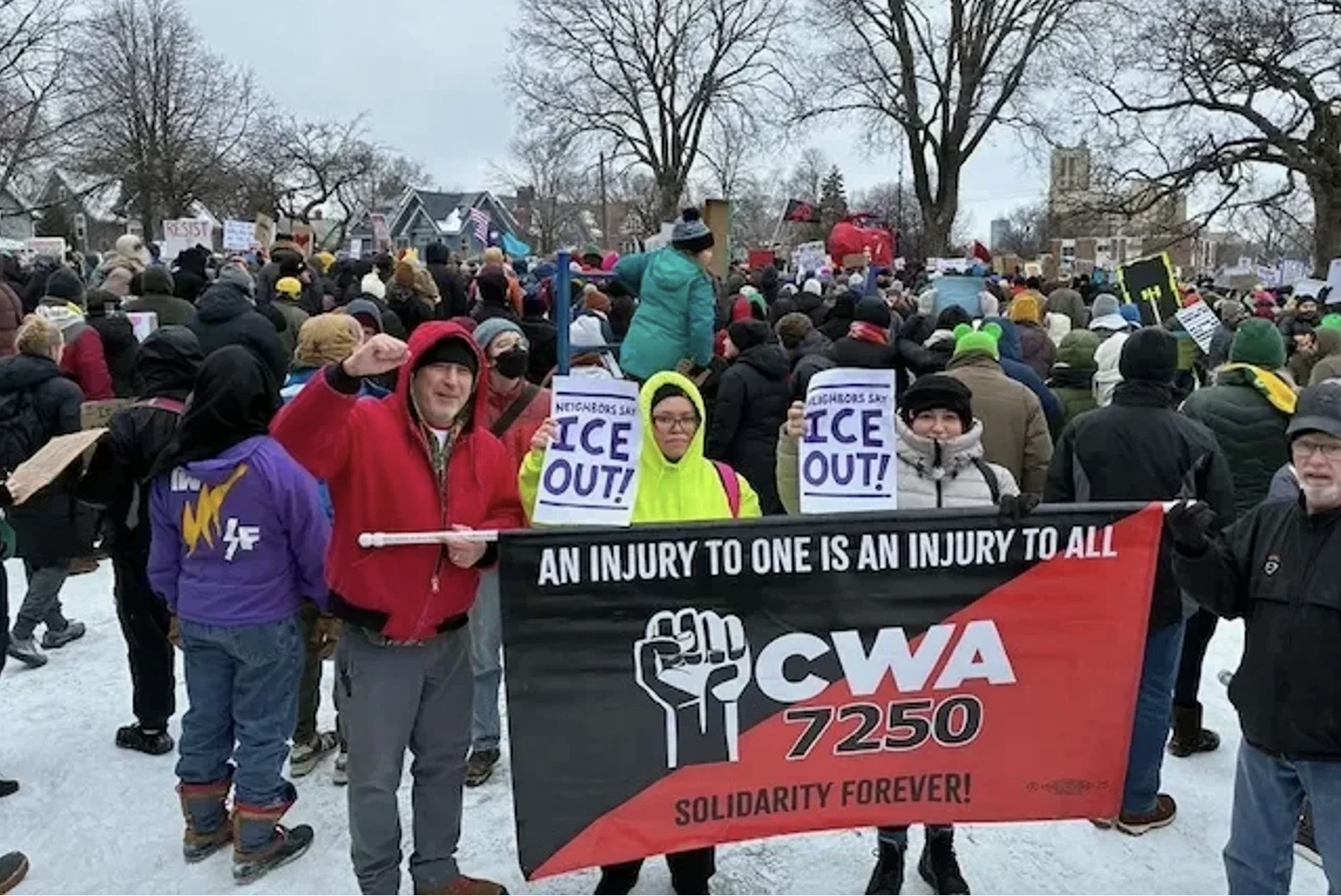
Tomorrow, tens of thousands of workers in Minneapolis are expected to take to the streets in a mass general strike. The “Day of Truth and Freedom” has been endorsed by all the major labor organizations in Minnesota. Every major school and cultural institution, as well as hundreds of restaurants and small businesses, are expected to close.
Likewise, Payday Report’s Strike Tracker has documented at least 215 solidarity actions around the country tomorrow. Labor leaders in Minneapolis hope tomorrow’s strike becomes a model for how labor and community leaders around the country respond to ICE attacks on their cities at any time.
On Tuesday, CWA Local 7520 President Kieran Knutson talked to Payday Report and our readers about how the Minneapolis General Strike movement emerged and what is next. He emphasized that he hopes that Minneapolis shows other cities how to fight back when ICE comes to occupy their cities.
(Watch Knutson talk lessons for the labor movement here)
Knutson says that the idea of a general strike emerged when SEIU Local 26 proposed a mass day of action to a group of progressive unions. SEIU Local 26, whose members are largely immigrant janitorial workers, sought help from other unions in fighting back as their members took a beating from ICE raids.
“After Renee Good was killed, I think a lot of us said, we have to move. We have to do stuff now,” Knutson, whose CWA local was the first union to back SEIU Local 26’s call, told Payday Report.
He says Minneapolis labor learned from the mass walkouts following George Floyd’s murder by police in June 2020, when more than 600 strikes occurred in the month after Floyd’s death, according to Payday Report.
“[The Twin Cities labor movement] has an experience with struggle and an experience with relating to social movements that emerge from the community, and as they emerge from the community, they infect the workplaces. And if the unions are listening, the unions can become a part of it as well,” says Knutson.
The strikes after George Floyd’s murder in 2020 were not traditional labor strikes in the sense that they weren’t called by unions. Many of them were called organically online by workers simply walking out. Also, many small businesses closed in solidarity with the protest, creating energy that led to a citywide shutdown.
(For more on the 2020 strikes after the murder of George Floyd, check out Payday Report’s seminal piece “How Black & Brown Workers Are Redefining Strikes in the Digital COVID Age”)
Technically, it's illegal for unions to call for a strike, so unions are referring to it simply as a “Day of Truth and Freedom”. However, immigrants' rights and community groups do not face those restrictions. Posters around the Twin Cities have urged, “No Work, No School, No Shopping Jan 23rd.”
“Flexibility is important. I also think having initiative and decentralizing the campaign, letting different people put their own sort of stamp on it, is just a normal way movements exist,” says Knutson.
Already, hundreds of restaurants, bars, and grocery stores have announced they will close in support of the strike movement.
“There's a big part of [the small business community] that is sympathetic to us, in part because they, so many restaurants have lost their kitchen staff because people are hiding,” says Knuston. “I think small businesses that are going to get on board, that's good. It helps create the sort of environment in the city of the city shutting down.”
More than that, with many business leaders in the city backing the strike, it puts pressure on employers not to retaliate against or fire workers who do take off on Friday, January 23rd.
“I think a lot of them are not going to want to be the poster child for the enemy of this movement,” says Knutson. “If somebody fires somebody for the strike, fucking put their name up there, and there's a good chance they will be going out of business soon, or they are going to be paying a big cost for what they're doing.”
The strike also features an element of consumer boycott, with organizers telling supporters not to go to school, not to go to work, and not to shop. In particular, the groups are singling out Target, which has faced criticism for cooperating with ICE. Target is one of the largest employers in Minneapolis, with naming rights to the city’s baseball field and NBA/WNBA arena.
Knutson thinks that going after major employers like Target and Home Depot, which have been cooperating with ICE, could create opportunities for unions to organize them.
Many labor leaders in Minnesota are excited about the possibilities of what the strike could inspire, not just in their state but nationwide. Already, more than 215 solidarity actions have been organized across the nation, according to Payday’s Strike Tracker. More cities could see strikes if ICE attempts to occupy them, as in Minnesota.
Already, the May Day Strong coalition is calling for a massive mobilization and strike on May 1st against ICE and the Trump Administration.
“On May 1st 2026 we need to take what the people of MN are going to do this Friday January 23 to the entire country,” says Neidi Dominguez, a veteran union organizer, Executive Director of Organized Power In Numbers. “We are not going to work, we are not going to shop, and our kids won't go to school that day.”
Knutson says that organizers in Minnesota are looking forward to what their strike could mean for changing their labor movement, but as new tactics emerge, they will constantly have to evaluate them.
“This isn't just a one off. What I want it to be is something that delivers a blow and shows how serious we are, and provides some lessons for us learning in terms of building the movement, but also provides some ideas about how to take the next step,” says Knutson. “And what does the next step look (like), what does it take to shut down the cities for a sustained amount of time?”
