
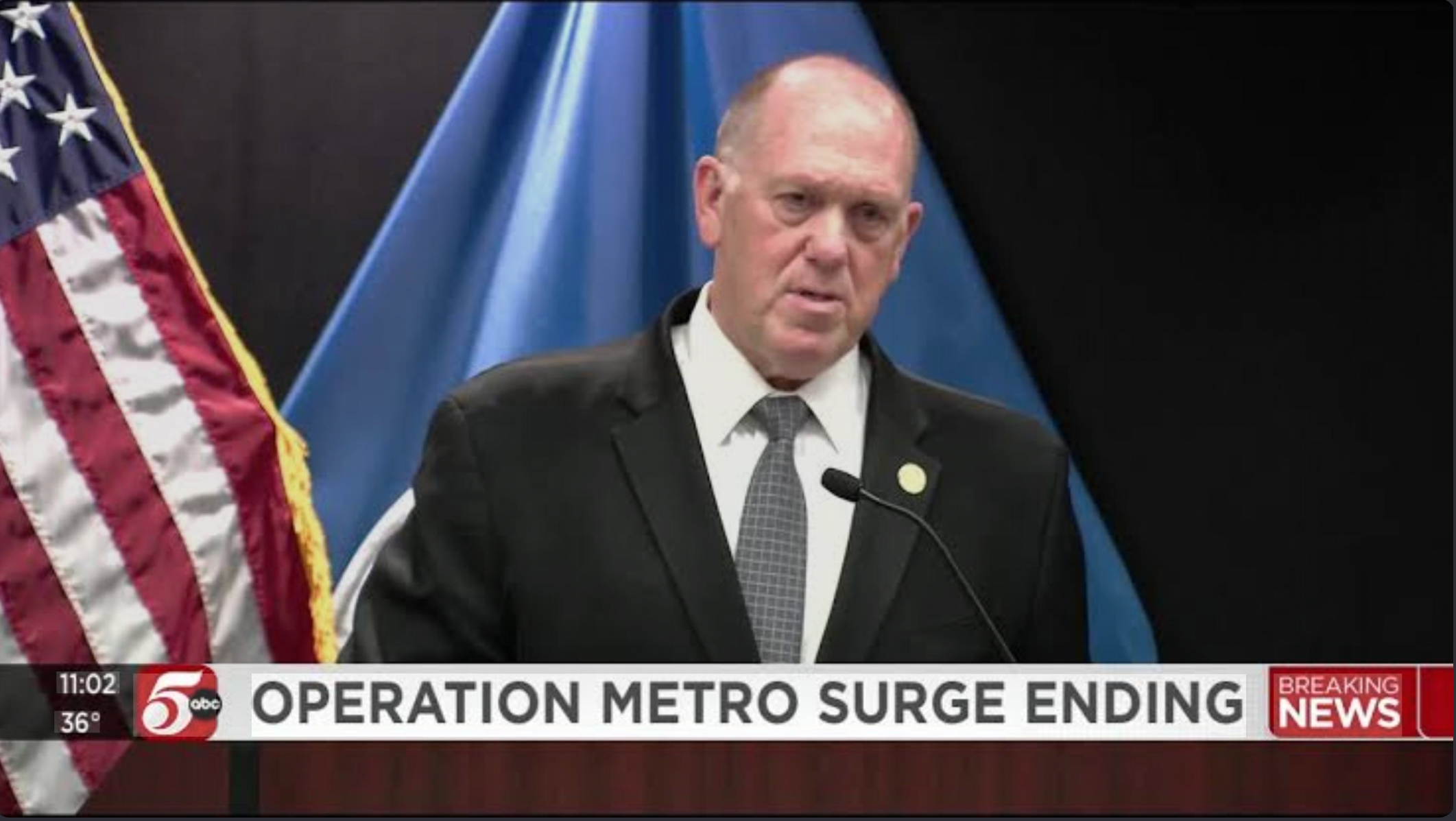
Earlier today, Trump’s Border “Czar” Tom Homan announced that “Operation Metro Surge” in Minnesota would be ending. Homan pledged to draw down the more than 3,000 federal agents currently stationed in Minneapolis, saying that local authorities had agreed to cooperate more with ICE.
“We have obtained an unprecedented level of coordination from law enforcement officials that is focused on promoting public safety across the entire state,” Homan said at the press conference announcing the drawdown expected to take place over the next few weeks.
The move comes after Senate Democrats had obtained the necessary number of votes to pause funding for the Department of Homeland Security following the murder of two legal observers, Renee Good and Alex Pretti. The Trump Administration is hoping that reducing the dramaticness of actions in places like Minneapolis may satisfy Senate Democrats and secure funding.
Labor leaders in Minnesota, who organized a massive General Strike on January 23rd that saw over 900 businesses close and 23% of voters participate, celebrated the withdrawal as a victory for worker mobilization. The action also led to more than 300 solidarity actions nationwide, according to Payday Report’s Strike Tracker.
“The 'conclusion' of the Operation Metro Surge state racist terror campaign is both a victory for the popular resistance and a transition to a dangerous new period,” said CWA Local 7520 President Kieran Knutson, one of the first local union leaders to call for a General Strike.
However, Knutson warned that he was concerned about the willingness local Democrats have shown to cooperate with ICE more if they stopped the mayhem that engulfed the streets of Minneapolis.
“We may not ever know the full extent of the ‘deal’ that lead to Homan’s announcement today, but it clearly includes two elements important to the Federal regime: access to immigrants who are arrested or detained in county jails - thus transforming more of local law enforcement into an arm of the ICE terror and mass deportation campaign,” said Knutston, adding that it also contained ”continued repression of the anti-ICE resistance, including the City’s campaign against the street blockade/roundabouts.”
Knutson also warned that ICE may be able to continue detaining immigrants through pledges of cooperation from local law enforcement authorities. He warned that throughout the uprising against ICE, local police often seemed more than eager to help ICE out.
“I saw with my own eyes the Minneapolis Police Department (MPD) and Hennepin County Sheriffs protect ICE’s flank while ICE fired hundreds of rounds of tear gas, rubber bullets, and flash-bang grenades at the resistance in the immediate aftermath of the execution of Alex Pretti,” wrote Knutson. “The MPD and Sheriffs Dept. later opened a corridor (using mace, tear gas, and ‘non-lethal’ ammo, themselves) for the ICE killers to escape.”
Immigrants’ rights activists are also concerned that the withdrawal of thousands of federal agents from Minneapolis could simply lead to a transfer of these agents to intensify ICE operations in other cities.
Already, immigrants’ rights activists in Pittsburgh say that they are seeing a major intensification of ICE efforts in the region.
“We would probably get maybe like 10 to 15 calls a week, and we got like 10 to 15 calls in a day,” says Casa San Jose Executive Director Monica Ruiz.
For now, labor leaders like Kieran Knutson fear they may be letting their guard down following the withdrawal of ICE surge elements from Minnesota.
“Instead of pushing our advantage, the official labor movement has backed away from our strengths and seemingly retreated back to lobbying the powers that be,” said Knutson. “One of the problems that all insurgent movements face is the lack of organizations and institutions that are willing and able to become or help nurture popular councils of mass democratic decision making.”
Some labor leaders, following the success of the January 23rd Minnesota General Strike and the success of the January 30th shutdown, which led to thousands of businesses and schools closing in over 140 cities, according to Payday Report’s Strike Tracker, are now calling for a massive nationwide General Strike on May 1st, International Workers' Day.
“I don't think rank and file union members are waiting for their international to give them permission to act,” says Neidi Dominguez, a veteran union organizer, who is leading the May Day Strong Coalition. “And I think many of them end up finding either community groups or their own local organizing as the outlet to move. If I were a betting woman, I would put my money on local people pushing those bigger institutions up top.”
(For more, check out the article “Labor Leaders Warm to General Strike Nationwide on May 1st”)
To keep the energy of the General Strike movement alive, some labor leaders in Minnesota have embraced the idea of the Workers Solidarity Circle-initiated Workers Assemblies. Already, Amalgamated Transit Union 1005
Communication Workers of America 7250, Minneapolis Federation of Educators 59, the Education Support Professionals chapter, and a number of left-wing groups, including the Twin Cities DSA, have signed on to the Worker Assembly effort.
These Workers Assemblies will allow rank-and-file workers outside the traditional structure of organized labor to mobilize support for both union groups and informal non-union groupings, who were crucial to the January 23rd General Strike's success.
“Without new forms of self-organization, the community cedes back our power to the collaborators and their state - who have diametrically opposed interests and goals,” writes Knutson. “Fascism and the system that breeds it must be defeated! Build Working-Class Power!”
