
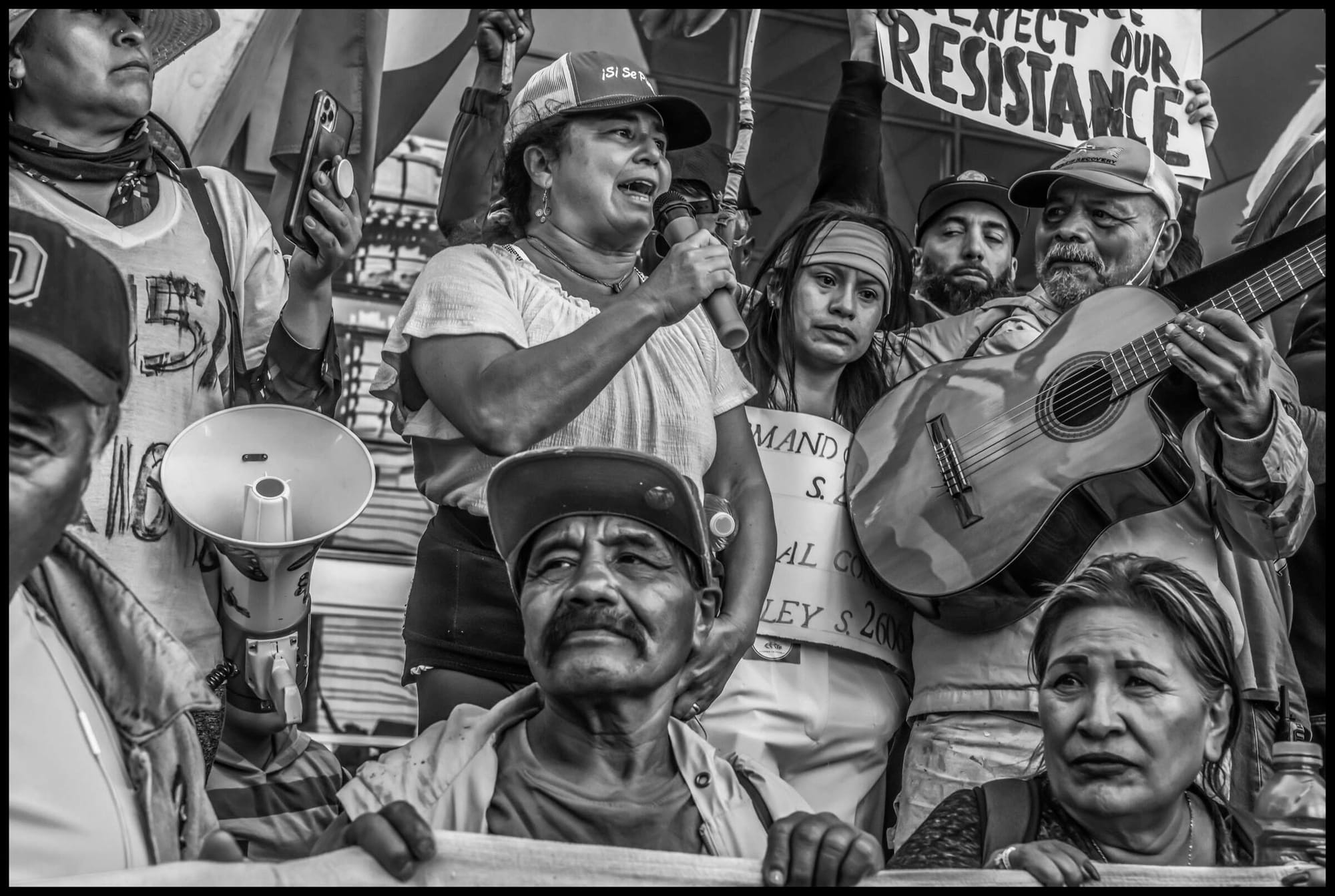
The following story from the great veteran labor reporter David Bacon is crossposted from Truthout with permission.
In late July, Raul Calvo, a well-known California union-buster, called workers at the Rodney Strong Vineyards into a meeting. Salvador Ramirez, who’d labored among big wine tanks for 12 years, says he was shocked by what he heard. “He said he was just going to give us the information that he got in an email three days ago, that ICE [Immigration and Customs Enforcement] was here outside,” Ramirez remembers, noting that Calvo told workers the vineyard was technically in a border zone due to its proximity to the ocean.
Ramirez says workers were very upset — not just by Calvo’s implied threat, but because the company’s attitude had changed drastically. Last October, when there were rumors that ICE agents planned a wave of raids in the San Francisco Bay Area like those underway in Los Angeles, the company had called everyone into a meeting. Ramirez recalled, “‘You’re our workers,’ they told us. ‘We have to support you and we’re not going to allow them to come in [without a judge’s warrant]. We’re going to take care of each other.’“
Calvo did not respond to Truthout’s request for comment.
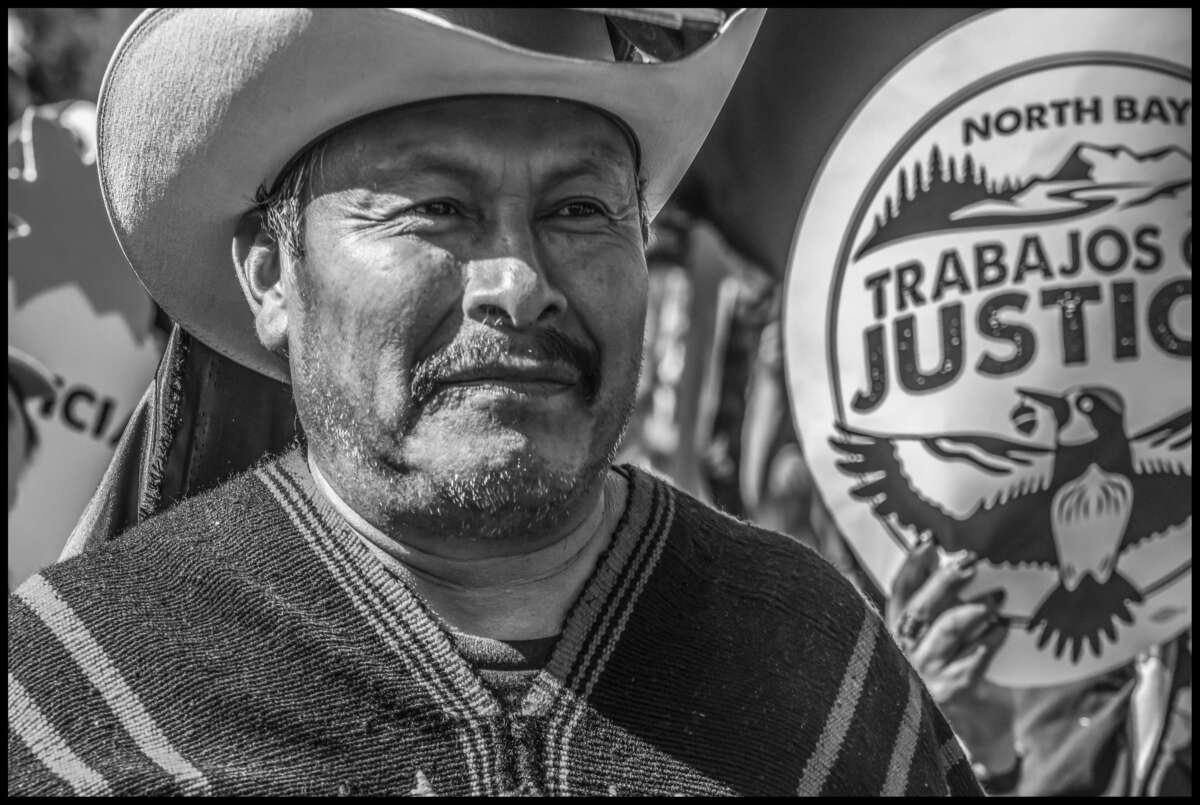
In the months afterwards, however, workers began talking with each other. They then reached out to North Bay Jobs with Justice (JwJ), a coalition of community organizations and unions in Sonoma and Napa Counties with a long history of fighting for workers’ rights. North Bay JwJ helped them organize a workplace committee, and put them in touch with Teamsters Local 665, a union with representatives on the organization’s board.
Ramirez and 31 of the winery’s 50 workers signed a petition asking that the company agree to a card check process for recognizing the union they’d formed, and for a “fair process to exercise our right to organize and form a union without threats and intimidation.” At the beginning of June, they took it to management. Rafael Malfavon, whom the workers call “Junior,” presented it and asked the company to accept their decision. Community leaders — including Chris Herrod, the mayor of Healdsburg — went along to support them.
The company’s response was to hire a local union-buster, Jesse Rojas, who held two meetings with workers. Then Calvo, Rojas’s boss, showed up. When he challenged Calvo in a meeting over misstatements about unions, Malfavon says he was ridiculed. “That just proved to us that the company won’t listen to what workers are saying and what we’re asking for, and hired this dude who calls me a liar,” he said.
Workers formed a delegation and went to Becky Oseguera, the company’s human relations director. According to Ramirez, “One of us said the company had brought in these people and they were trying to intimidate us with the migra, and that wasn’t right. I said, ‘We believe this is a very serious line that’s been crossed.’ She told us, ‘Don’t you see that I’m very busy, with all this stuff that you’re doing?’”

Why Workers Organized
Ramirez and his co-workers started organizing in part because the company was terminating longtime workers. “They started having meetings with us,” Malfavon recalled, “saying they had to cut their budget. No one would get bonuses like before. We noticed that we weren’t getting raises while we had to do extra work, and they wouldn’t hire people to help. But the executives were getting promotions.”
One fired worker was Belen Flores, who had banged her knee at work and was then let go by the company, citing a genetic vision problem as a pretext. “I could always do my job to the last day,” Flores said. “I never got even a warning.”
Ramirez was incensed. “She’d been working here for nine years, and they fired her just like that,” he said. “There were rumors that there are five more people on the list after Belen. I could see the future that awaits us.”
Malfavon said that when his brother was terminated, he asked the company for some explanation. “They didn’t want to answer any of my questions. I had no words. I literally sat in the corner and started crying. I felt so powerless.”
The terminations came on top of increasing economic pressure. Despite working at Rodney Strong while also holding another full-time job, Malfavon is still living at home with his parents. Two-thirds of the people working in the winery have second jobs, he says. Malfavon is desperately trying to save enough money to set up a new home with his wife in Sonoma County. “It’s a huge step I’m making. I work over 80 hours a week, all the time, and I can’t meet the rent. I just have three pairs of pants that I’ve had for six years.”
Although winemaking has the image of a small-scale craft, in reality it’s a major industry in which workers labor in factory-like environments with huge tanks and pipes in buildings that can seem endless. It is dangerous work where insufficient safety measures can put workers’ lives at risk, and accidents can have catastrophic consequences. The deadliest hazard is work inside the tanks, cellars, and confined spaces, where a person can be quickly overcome by carbon dioxide and other gases.
In the last two decades, casualties included Gustavo Javier Muro at Ancien Wines and Salvador Plaza-Centeno at Dry Creek Vineyard. Leon Marcelo Lua was drawn into a machine, another industry hazard, after he’d been working for 10 hours at De Coninck Vineyards. Other wine industry laborers have died in falls or been crushed by machinery.
Rodney Strong Vineyards does not have a record of industrial accidents causing major worker harm, but six years ago, 97,000 gallons of cabernet sauvignon wine poured from a tank when a door popped open, ending up in a creek feeding the Russian River. While no one was hurt, anyone in the path of the wine could have been overcome and swept through tanks and machinery.
Why Workers Want a Fair Process
For workers, the ability to work safely is guaranteed not just by company or government protocols, but by their own power on the job. To win that power, they want a “fair process,” as they outlined in their petition. This process does not use the election machinery of the National Labor Relations Board (NLRB), but instead seeks a neutral party to verify that a majority of workers have signed cards or a petition. According to Local 665 President Mike Yates, this process was used recently by workers at a local Ready Mix concrete company. Other workers have used it at Sonoma County hotels.
Christopher O’Gorman, Rodney Strong’s senior director of marketing communications, sent Truthout a statement saying the company respects workers’ right to decide on unionization, but wants an election supervised by the NLRB: “A Card Check Neutrality Agreement limits our ability to share information with employees, reduces transparency, and, most importantly, replaces the protections of a secret-ballot election with a process that does not provide the same level of privacy for employees making this important decision.”
Rodney Strong workers want a card check because they believe the process administered by the NLRB is manipulated by companies and union-busters like Calvo, while the Trump administration has biased the board even further against workers and unions. During the Biden administration, Jennifer Abruzzo, general counsel for the NLRB, issued a memo holding that certain captive-audience meetings were illegal. Those meetings are mandatory for workers, who are required to listen to harangues about the dangers of unions and organizing.
Donald Trump fired Abruzzo and replaced her with Crystal Stowe Carey, a partner in the notorious anti-union law firm Morgan Lewis. Carey then announced she would overturn that ruling, making mandatory meetings with union-busters legal. The Senate recently confirmed a new Republican majority on the NLRB, committed to that and other reversals of pro-worker rules and procedures.
The meetings held by Rojas and Calvo might have been borderline legal, since they were not mandatory, and some workers even chose to attend in order to refute the propaganda barrage. But using immigration threats to scare workers and create an atmosphere of fear is certainly a violation of labor law. Unfortunately, enforcement of that law and workers’ rights now lies in the hands of Carey and Trump’s NLRB. Workers might reasonably lack confidence that they will ensure Rodney Strong Vineyards refrains from retaliating against union supporters.
Instead, the organizing strategy of Jobs with Justice and the Teamsters at Rodney Strong depends on a strong commitment by workers to build their union inside the winery, and on the Sonoma County community to act to support them. When the workers began this process, “I was scared and I still am a little,” Malfavon said, “but I’m getting over that fear because they’re just trying to intimidate us to make us stop.”
Workers had confidence in this course of action, urged by JwJ and the Teamsters, because both have a track record in Sonoma County. “My wife and my children have come to marches and protests,” Ramirez said. “They see that we don’t fight alone, that there are people who have the same goals we want to achieve — a better quality of life for our families. So we’ll keep going until we get what we want.”
A Track Record of Coalition-Building to Defend Workers and Immigrants
For several years, North Bay Jobs with Justice has campaigned for higher wages to compensate workers for the risks and health impacts of work in heavy smoke during the forest fire season. In 2022, JwJ and supporters went to the Sonoma County Board of Supervisors, demanding stiffer protection requirements for growers who ask permission to send workers to harvest grapes in wildfire evacuation zones. The companies brought in Raul Calvo, who organized an astroturf group claiming to be farmworkers to show up at a supervisor meeting in T-shirts saying “NB [North Bay] JwJ does NOT Speak for Me.” Calvo also conducted captive-audience meetings for wine industry workers to combat the campaign.
Since 2020, Calvo has not filed the LM-20 and LM-21 forms the Department of Labor has required from anti-union consultants. There is no record of the money growers paid for his campaign against fire protections for workers, or how much Rodney Strong Vineyards is paying now. Rojas was listed as a consultant to Calvo on a 2020 form for work in another union-busting campaign, for which he was paid $283,633.
Workers exposed Rojas’s 2020 payment in a leaflet to local activists. “Our community has responded in a very positive and supportive way,” said Renee Saucedo, coordinator of the Sonoma County Sanctuary Coalition and director of the Raizes Collective, an organizing project among immigrant women workers. “Many of us have come to pickets co-sponsored by the Teamsters and Jobs with Justice, and we are ready to act.”
Rodney Strong workers have offered support to the broader community in return. When Malfavon went to a meeting of the Sonoma County Tenants Union, “it was inspiring,” he said. “I saw other people going through injustices, and then you see yourself in that. As much as they want to support us, I want to support them, to grow bigger and be more united in general.”
So far, according to Yates, community activists have mobilized at least three times. In addition to accompanying workers when they handed management their petition, 200 people picketed a summer event, causing Rodney Strong to cancel it, and 250 attended a counter-demonstration to a company disco night fundraiser. Public officials also refused to cross the workers’ picket line. “No one believes the company’s claim that they’re looking for an open and transparent process,” Yates said, “when they threaten the workers in the same breath, using hired guns to scare them.”
For many community organizations, the use of immigration scare tactics highlighted a larger danger of industry cooperation with immigration enforcement. Over the past year, Sonoma County has witnessed a growing wave of demonstrations opposing the county sheriff’s policy of turning people incarcerated in jail over to ICE. So far in 2026, the sheriff has handed 21 people to ICE for deportation.
When the Sonoma County Farm Bureau, representing the largest wine industry employers, defended the sheriff’s actions, the Sanctuary Coalition held a die-in and press conference outside its offices. In a statement, Dayna Ghirardelli, executive director of the Sonoma County Farm Bureau, said the agency favored enforcement that targeted “criminals.”
“Our farms and ranches depend upon immigrant workers,” she said. “But respect for immigrant families does not require abandoning common sense. In fact, if it were legally possible, I would support deporting some individuals convicted of the most serious and violent crimes who are U.S. citizens as well.”
The North Bay Central Labor Council, to which Local 665 belongs, rejected that argument and urged the Sonoma County Board of Supervisors to pass a “Non-Collaboration With ICE” ordinance. “Sonoma County is not safer by providing information to ICE. Quite the opposite,” the labor council wrote to supervisors in a letter. “The recent killings by ICE and US Border Patrol agents in Minneapolis, by poorly trained agents, tell us that nobody is safe under these conditions.”
Saucedo responded to Ghiradelli: “How can employers of immigrants, including undocumented immigrants, say that they support workers when they are supporting policies that clearly hurt them?” While Rodney Strong Vineyards is not a Farm Bureau member, Saucedo says Calvo’s statement to its workers was not an aberration. “Employers are increasingly using the threat of ICE when workers complain about working conditions and wages. In the world of domestic workers, employers make constant threats to call ICE.”
By the same token, restraining the ability of wineries and growers to weaponize fear of ICE and deportation can create a more supportive environment for workers trying to organize. “When we see companies threaten people with immigration status, or with the loss of wages or the closure of their workplaces, we’re going to take that on,” said Alejandro Negrete, the organizing director of Teamsters Joint Council 7.
Saucedo believes the campaign is creating stronger partnerships between community-based organizations and unions. “It’s pushing unions to do more to organize as equal partners in communities of immigrant workers,” she said. “Immigrant rights and workers’ rights are inseparable and must be defended together.”

From the Wineries to the Fields
Creating that supportive environment may also help in organizing field workers who pick the grapes for the wineries. Local farmworkers face not only the possibility of detention and deportation, but the loss of their jobs. In the last decade, Sonoma and Napa County winemakers have brought a growing wave of immigrants to work in their fields under the H-2A visa program. Last fall, the Trump administration cut the legally required wage for these temporary contract laborers by $3/hour in California, and now is allowing growers to charge them another $3/hour for the often substandard housing they formerly had to supply for free. Workers who protest abusive conditions, including these changes, can be fired at will, and are then blacklisted by recruiters.
According to Marcos Lopez, research director for the Labor and Community Center at the University of California, Davis, in 2008 the Department of Labor certified Sonoma County growers to fill only 92 jobs with H-2A workers. Last year, that had grown to 1,639 jobs, about a quarter of the wine industry jobs in the county. Those workers stayed not just for the 10-12 week harvest, but for an average of 39 weeks.
“The H-2A program has led to the casualization of labor for local workers,” Lopez said. “Local residents, who once held year-round positions, are increasingly hired only during peak seasons, like the harvest, essentially as a temporary workforce.”
JwJ organizer Max Bell Alper says local farmworkers fear that they can be displaced at any time. “People were experiencing a shitty job already,” he said, “and it was getting worse. But they’re desperate for the work they have, and as H-2A recruitment mushrooms, they have not been ready to organize.”
One way to break that fear, Alper says, is by setting a new standard for wages and job security among workers in the wineries, who often belong to the same families as those working in the picking crews. “Let’s establish that standard, and then let’s fight for the field workers to have that too,” Alper urged. “We need some fights, which farmworkers can be a part of as well.”
“For decades, the Sonoma County wine industry has generated immense wealth on the backs of workers,” added JwJ organizer Gabriel Cardenas. “But the current economic conditions are unsustainable for workers, and that’s leading to a growing realization that collective action is essential for survival.”
Malfavon believes organizing Rodney Strong Vineyards will therefore help everyone. “This is for the field workers going out there at two or three in the morning, for the truck drivers that put in countless hours with no sleep, and for every other worker in the winery, from the people that sell it to the people that consume it,” he said. “I want them to see how many people it takes for them to actually enjoy a nice bottle of wine. I want them to see what we’re fighting for — to make our voices heard.”