
The following story by Katherine Burgess, a reporter at MLK50: Justice Through Journalism.
T’arrah Mathis loves doing storytime with neighborhood children at the historic Orange Mound Library, where she works.
Memphis Public Libraries supported her work as the author of children’s books, Mathis said, so she seized the chance to become a library assistant. At the library, the work is all “about relationships” with the kids and other community members, she said.
“They trust us,” Mathis said. “We build relationships. We help with homework. We help with providing clothing for some of the kids that we know are having issues at home. We feed them. … I like to say that librarians are really like community heroes, everyday heroes. We’re there.”
But library workers in Memphis, from librarians to material processors, have fewer legal protections than most city employees because they are currently considered “appointed” by the mayor. Most city workers are civil service employees. Library workers are fighting to be reclassified, but also to have their union recognized by the city. The workers interviewed in this article spoke as union members, not on behalf of the city of Memphis.
Many library workers make less than $44,000, the living wage for a single person with no children living in Memphis, said Laura Bontrager, who works in the sciences department at the Benjamin L. Hooks Central Library. The City Council approved a measure Nov. 18 that would set the minimum salary for city workers at $40,000.
While pay is important, it isn’t the only issue motivating the union push, the workers say. Memphis’ libraries have become even more essential as federal cuts have targeted workforce development programs, homelessness funding and more, spurring calls for the city to improve safety, address languishing repairs and increase staffing levels.
“We need real action, real commitments and dedication to show that you do support and appreciate your libraries,” Mathis said.
Workers want better pay, protections, and a voice at the table
The city of Memphis has 18 library branches, and its workers have a broad range of responsibilities: Some order, catalog and deliver books. Others curate a “Library of Things” with items ranging from karaoke sets to sewing machines, and organize events ranging from children’s story times to fantasy fairs. Workers build robots with teenagers, research resources for library users, work on the library’s website, teach classes on job skills and more. The libraries offer health fairs, genealogy classes, arts and crafts and summer camps.

While the libraries are often touted as bright spots for the city, workers say they are under-resourced. At Orange Mound, a branch that just opened last year, workers spent much of the summer with no air conditioning, Mathis said. There have also been problems with accessibility infrastructure and doors not working.
Safety is one of the largest concerns for library workers, particularly those at the smaller branches across the city. Last year, there was a suicide at the Central Library. In 2023, a Memphis police officer, Geoffrey Redd, died after being shot while responding to a confrontation at the Poplar-White Station Library, which was renamed to memorialize him.
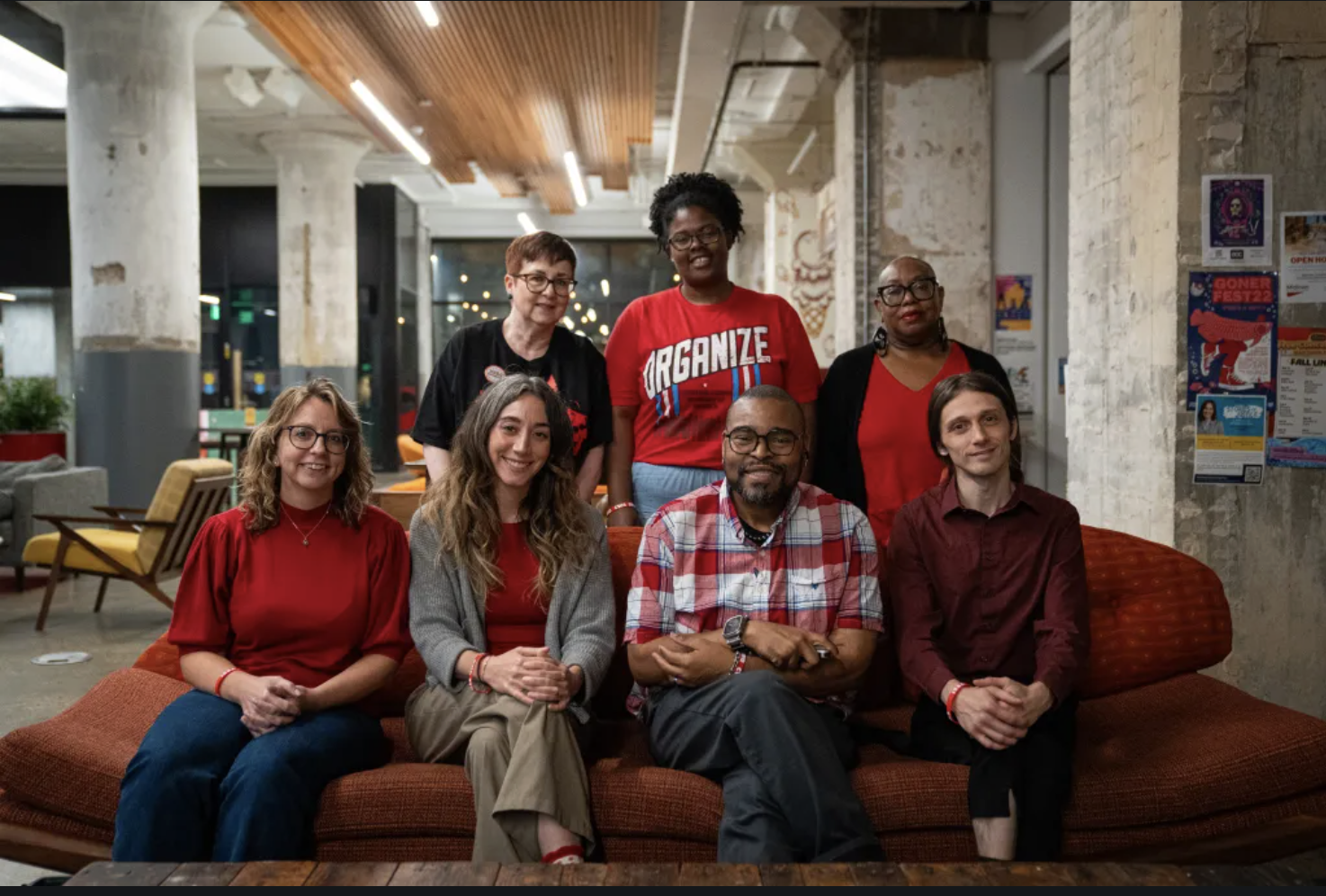
A group of seven library workers who gathered to speak to MLK50: Justice Through Journalism, recalled dealing with bullet holes in library windows that weren’t fixed for years, a serial exhibitionist, people overdosing in the bathroom and feces smeared on a front door. Branches need security before 1 p.m., they said, and workers need “better resources, more communication,” said Susan Berry, a retired librarian who continues to volunteer at Parkway Village Library.
“When a child walks up to the library, and he sees four bullet holes in the windows that have not been fixed like that, you are telling that child what he is worth, that he is worth a broken-down building with bullet holes,” Berry said.
Workers at branches also regularly have to work Sunday shifts at the Central location, which requires an entirely different skillset, “like having a second job,” Bontrager said.
And without parameters on work-life balance, a work week can easily end up being 11 days in a row, Berry said.
Despite these challenges, the workers say they “want the library to be for everybody,” said Anthony Lucatelli, a librarian who’s worked in several library branches since 2019 and is currently at the Central location.
It was Lucatelli who sparked the union campaign back in 2024, when they reached out to the Communication Workers of America.
“There was just this constant refrain amongst my coworkers that nothing could or would ever change, and that it was pointless to make things change,” Lucatelli said. “I just thought that we needed a seat at the table, because we were the ones who saw the problems as they were happening, and we’re the ones who had the ideas for how to fix them… I didn’t want to feel powerless.”

Appointed status means fewer legal protections, workers say
Unlike other city workers who have formed unions, library workers are in the unusual position of being considered “appointed” rather than civil service. Appointed status normally applies to people like department heads, who occupy roles a mayor is likely to replace when creating a new administration.
That unique classification stems from how libraries used to operate separately from the city, said G. Wayne Dowdy, senior manager history department at Memphis Public Libraries. As a manager, Dowdy is not involved in the unionization efforts, but spoke about the history of the library and its employees. He has advocated for library workers to be moved from appointed to civil service, something he said would fix an “unequal situation.”
When the city’s first library, Cossitt Library, opened, the city provided land and operating dollars, but the library had its own board, Dowdy said. In 1973, the library’s place in city government was codified, but it wasn’t until March 2005 that library employees became city employees. An ordinance recognizing that change described library workers as among those “exempt from civil service.”
Since that change was made by the City Council passing an ordinance, Dowdy said it appears they could change workers from appointed to civil service through another ordinance or a referendum. Councilman J.B. Smiley Jr. said he is working on an ordinance that would put the question before voters in 2026, if approved by City Council. The City Council held its first discussion on such an ordinance on Tuesday.
The denial of bargaining rights to non-civil service workers appeared in a 1984 executive order from then-Mayor Richard “Dick” Hackett, Dowdy said. It’s unclear whether Hackett had the authority to issue that order or whether it applies to library workers today, since they were not city employees at the time.
Being appointed means no procedures or policies for hiring and firing and no formal grievance or appeals process, library workers said.
The city of Memphis did not respond to specific questions about its position on library workers wanting to move to civil service status or on whether it will recognize the library workers’ union.
“Our administration believes that every City of Memphis employee deserves fairness, stability, and dignity in their work,” a city spokesperson said in a written statement. “We share the same goal as our employees: a workplace where dedication is honored, service is respected, and every person feels secure in their role. The City is only as strong as its people, and we want to make sure our policies reflect that truth.”
Library workers’ unionization efforts come amid a push from the city to limit the power of its unions.
In an August counter-claim in a lawsuit between the Memphis Fire Fighters Association and the city, the city asked the court to determine that all memorandums of understanding between the city and its various employee unions “are not binding contracts.”
Allan Wade, attorney for the Memphis City Council, said those memorandums of understanding are meant to be “guideposts for how the administration and labor work in those specific disciplines like fire and police,” but that the city is not legally bound by them.
The city’s unions have pushed back against that counter-claim, including in a protest in October.

Alexandra Farmer, a librarian who has worked with the Memphis Public Libraries since 2024, said it still feels like the “ideal time” to unionize.
“Yes, I would love to be operating in an environment where the mayor is not currently arguing that all memorandums of understanding should be invalidated,” she said. “But it’s kind of beautiful to be in this moment with all of our union members and struggling for something. And not only are we at a moment where we can fight to try to win our union, we can try to fight to protect all bargaining rights in Memphis.”
The library workers say that while the effort may be difficult, they believe it’s worthwhile.
“We do see so much darkness, but we see so much of the beauty of people,” Farmer said.
People often walk into the library “depleted and so knocked down,” she said. But there, they find workers who are able to connect them to the resources they need, from getting help with a job application, to finding books on parenting to learning about robotics.
“One of the reasons we want to do this is not only for ourselves, but because we want to advocate for a stronger library system that can meet more of these needs that we’re seeing all the time,” Farmer said.
Katherine Burgess is the government accountability reporter for MLK50: Justice Through Journalism. Contact her at katherine.burgess@mlk50.com