
This article was co-published with the American Prospect
RIO DE JANEIRO – For months, polling on this fall’s Brazilian presidential election showed President Luiz Inácio Lula da Silva stuck in a neck-and-neck race with Sen. Flávio Bolsonaro, the 45-year-old son of former right-wing President Jair Bolsonaro.
Then, Lula, a former autoworkers’ union leader, began a massive public push to give Brazilians the long-sought-after goal of only having to work five days a week.
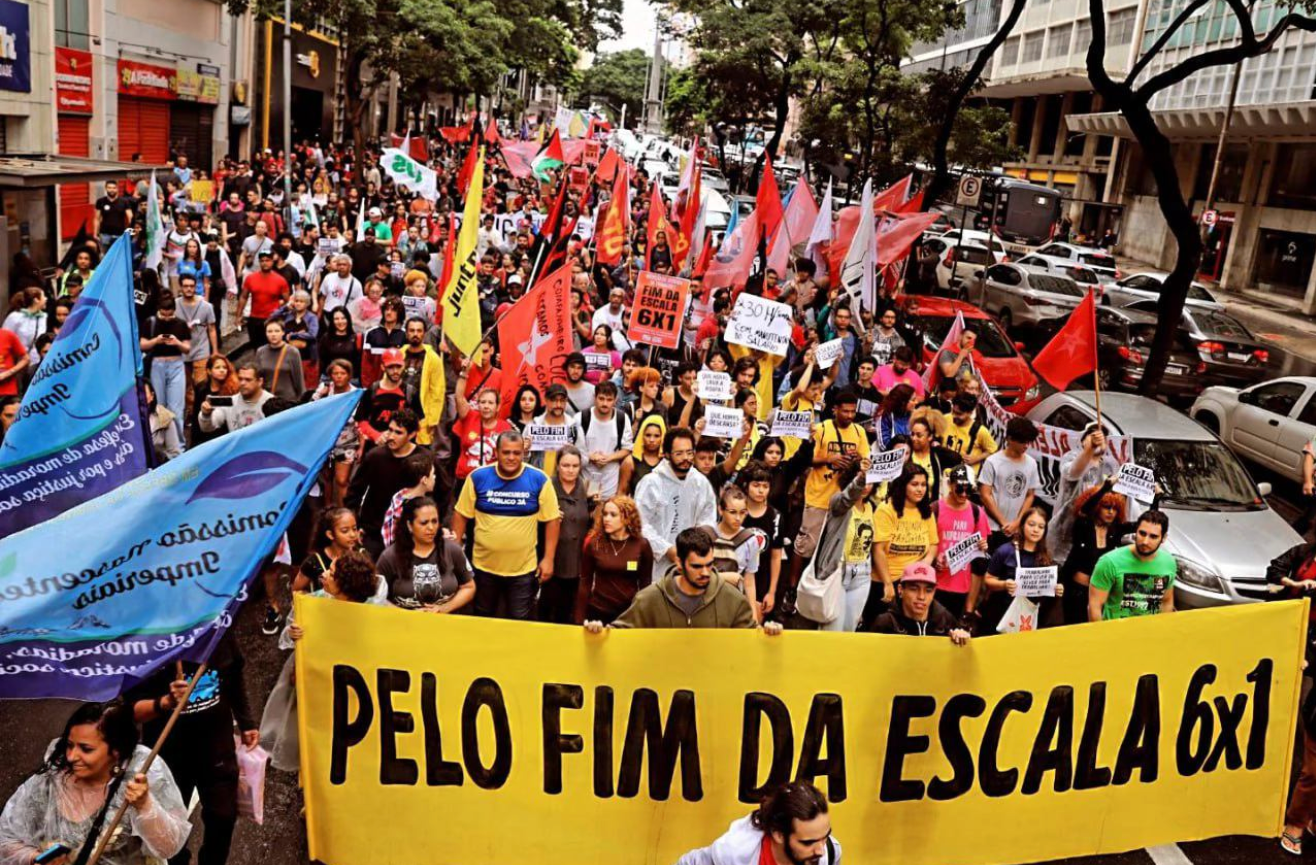
Under Brazilian law, workers must work six days to have one day off, a system known as “escala 6×1.” While most white-collar workers have the full weekend off, most blue-collar workers don’t have the right to the weekend.
Felipe Arrais, 47, works at a popular hotel on Copacabana Beach in Rio de Janeiro.
“I’m working six days and have only one day off, it is exhausting, you know. You don’t have too much to do besides work,” says Arrias.
“It’s a relic of the dictatorship, of the culture of slavery that has existed in this country for so long,” says Márcio Ferreira, president of Sintrabor, which represents over 20,000 tire workers in Brazil. “Many of our workers don’t have time to spend with their families because all they are doing is working all the time.”
Since the fall of the dictatorship in 1988, Lula and other Brazilian labor leaders have pushed for a 40-hour workweek, but their efforts to create one have been stymied. While wages and living standards have risen over the last few decades, they have never been able to overcome the employer lobbies in eliminating this rule.
But it has become a top priority for Lula, who demanded a 40-hour workweek without reducing overall take-home pay. Brazilian unions flooded the streets of all the major cities with massive demonstrations and the obliquos—massive balloons that accompany protesting.
Polling quickly showed that for politicians, few things were more popular than giving workers the right to take the weekend off. Fearing a massive electoral defeat if they opposed the push, Valdemar Costa Neto, national president of Bolsonaro’s party, the PL, instructed members to vote for it.
“If we don’t approve the [work schedule] proposal, Lula will win the election, and next year he’ll implement a 4×1 [work schedule]—he’ll sink the country,” Costa Neto told the right-wing Jovem Pan News in May. “We have to gain power; we have to return to government. And to return to government, we have to vote for proposals that the majority of the population supports; we can’t be against them. The majority of our deputies think this way.”
In May, the measure passed the lower house of the Brazilian Congress by a vote of 461-to-19, and while it still faces some obstacles in the Senate, most labor leaders expect it to pass. The success was a major boost to Lula’s campaign—and to workers across the country.
“It is about more than just hours on the clock; we are restoring workers’ right to spend time with their families. To rest. To a life beyond work. Two days off a week mean more time to study, have fun, look after their health, and watch their children grow,” said Lula in May after the lower house’s passage. “It is a victory, above all, for women, who—historically and unjustly—face a heavier, unequal workload. A measure that was only made possible thanks to the immense mobilization of society.”
Labor leaders say that the measure was immensely popular, contributing to Lula’s rise in the polls.
“This progress is very important, just in terms of reducing working hours, we hadn’t touched working hours for 38 years, so it was very important to give a civilizing character to people,” says Miguel Torres, president of the 2.1-million-member trade union Força Sindical.
LULA’S RESURGENCE IN THE POLLS also came after a scandal that the corporate media attempted to pin on him rebounded back on his opponent.
Last November, the financial institution Banco Master collapsed amid allegations of massive fraud. The bank was being run like a Ponzi scheme, resulting in the largest financial collapse in Brazilian history, with nearly $8 billion in investors’ funds lost.
Despite the CEO of Banco Master, Daniel Vorcaro, being a very vocal Bolsonaro supporter, the Brazilian media has repeatedly tried to link the scandal to Lula’s Workers’ Party, as Vorcaro cultivated political ties on both sides of the aisle.
Lula began to sink in the polls as the Brazilian corporate media tried to contact him directly about the scandal. At the same time, Lula’s son, businessman Fábio Luís da Silva, who is commonly known as “Lulinha,” was being scrutinized over large bank accounts worth millions of dollars.
For months, Lulinha has offered to open his books and claimed that he received no special favors from Banco Master. Still, the media repeatedly raised questions about Lulinha’s alleged impropriety.
At one point, media giant TV Globo made a giant infographic web with arrows, showing a complex network linked to Lula. Other reporters widely ridiculed the conspiracy theory map, and TV Globo eventually had to apologize on air publicly.
Then, in May, as Lula was generating headlines in his fight to shorten the Brazilian workweek, The Intercept Brasil released a WhatsApp message from Flávio Bolsonaro to Vorcaro, asking him for more than $26 million to fund a strange English-language biopic named Dark Horse, about his father. In the film, Jair Bolsonaro is portrayed by right-wing American actor Jim Caviezel, who played Jesus in the controversial 2004 film The Passion of the Christ.
In the WhatsApp message, Flávio Bolsonaro claimed that the project may default on payments to Caviezel and director Cyrus Nowrasteh. “We’re at a very decisive moment for the film and, as there are a lot of outstanding payments, everyone is tense … Imagine us defaulting on someone like Jim Caviezel, or Cyrus … It would be very bad,” Bolsonaro was heard saying.
The request was sent on November 15th, shortly after it was leaked that the Brazilian government was nearing a public takeover of Banco Master. Two days later, Vorcaro was arrested as he tried to flee the country for Malta.
The $26 million request would have made Dark Horse the most expensive film in Brazilian history, more than double the combined budget of I’m Still Here, which was nominated for a Best Picture Oscar in 2025, and The Secret Agent, nominated for Best Picture this year.
The audio was widely played in the media, leading many Brazilians to mock Flávio Bolsonaro’s desperate pleas to Vorcaro. Even Romeu Zema, the longtime right-wing governor of Minas Gerais, called out Bolsonaro for the clips, saying the messages were “a slap in the face to decent Brazilians,” as some on the right called on Bolsonaro to drop out of the presidential race.
Public opinion polling quickly showed that Lula was opening up a double-digit lead over Bolsonaro.
“It sank his campaign,” joked Kleber Mendonça Filho, the Oscar-nominated Brazilian director of The Secret Agent, on Facebook.
THIS MONTH, PRESIDENT TRUMP placed 25 percent tariffs on Brazil and 60 other countries, claiming a lack of enforcement of imports made with forced labor. The measure came after both Flávio Bolsonaro and his brother Eduardo visited the White House. Lula was quick to blame the Bolsonaro boys for getting the measures passed. (Eduardo Bolsonaro fled to the United States in 2025 as he faced criminal charges for his role in attempting a coup in Brazil. Recently, Eduardo was convicted for his actions.)
“These sons of Bolsonaro can be worse than him. They are actually sellouts of our country, they went there to ask a foreign nation to meddle in Brazilian affairs,” Lula said in a speech earlier this month. “They are traitors.”
Labor leaders are feeling much more optimistic about the election this fall.
“We are optimistic, but we still have a big fight ahead of us,” says Miguel Torres.
