
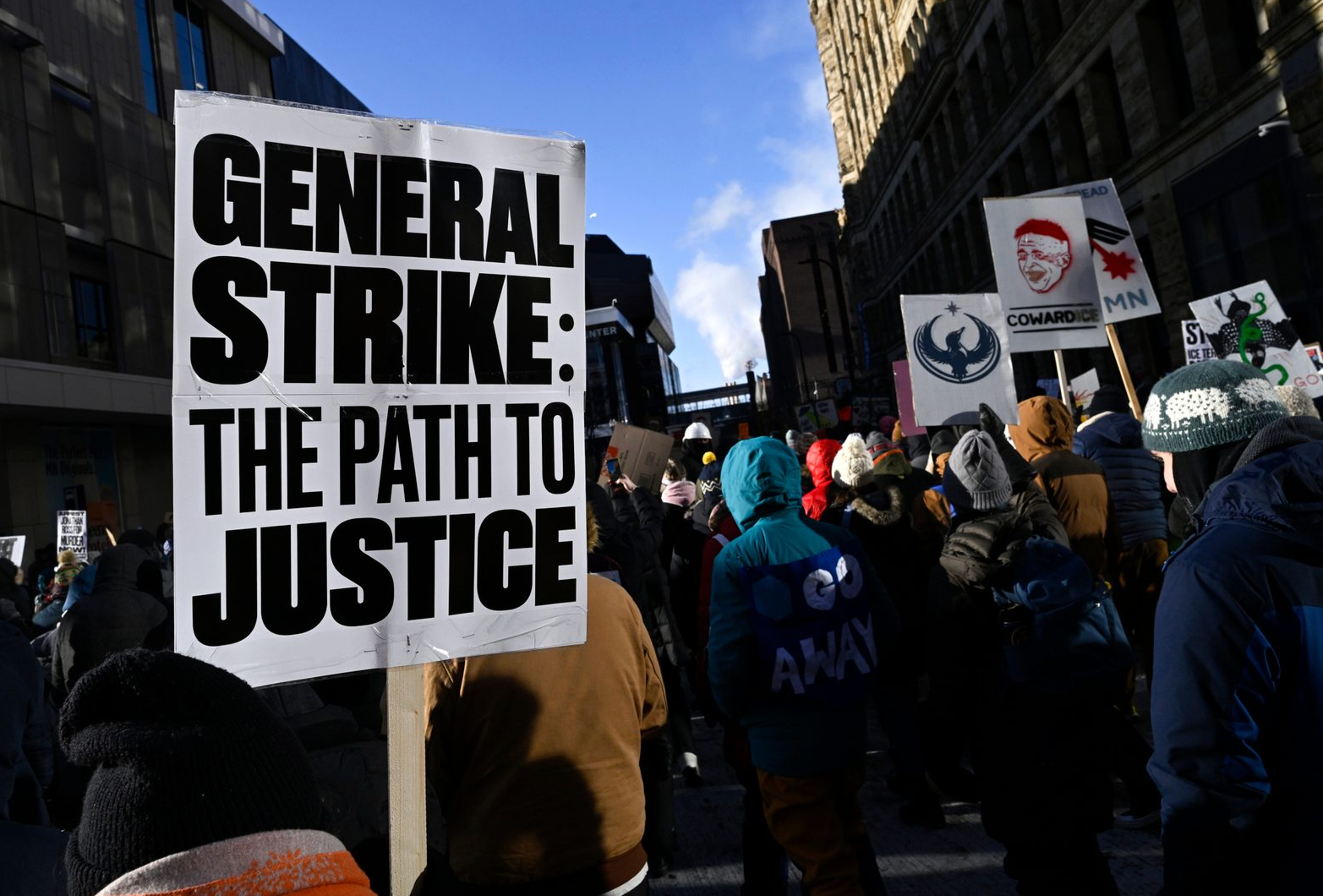
For many decades, activists talked about a nationwide general strike, but the idea was always dismissed as a left-wing fantasy.
Then, on January 23rd, Minneapolis went out on a general strike with support from major labor federations across the state. Over 100,000 marched in -30 temperatures as major school districts and at least 700 businesses closed across Minnesota. More than 300 solidarity actions were held nationwide, according to Payday Report’s strike tracker.
At least 23% of Minnesotans participated in the strike in some way, according to a survey of 1,900 registered Minnesotan voters conducted by the May Day Strong Coalition, a group of labor and community organizations advocating for a mass nationwide walkout on May 1st.
Neidi Dominguez, a veteran union and immigrants' rights organizer who works for the May Day Strong coalition, says she is hearing more and more labor leaders talk about taking dramatic action on May 1st similar to what happened in Minneapolis.
“I think unions, especially local unions, are getting creative and thinking through, how could they do that legally, and what would it take politically to do that,” Dominguez told Payday Report this week. “I think international unions are likely having the same conversations. I think, in general, unions, like everyone else, cannot ignore what's happening.”
Last week, on January 30th, several online groups, the Party for Socialism and Liberation (PSL), and celebrities like Arianna Grande and Pedro Pascal backed a call for a national shutdown. Unlike the Minnesota General Strike, no major unions backed the call, and even many left media outlets doubted it would amount to much.
However, thousands of businesses and schools closed in over 140 cities, according to an analysis by Payday Report’s Strike Tracker.
In Georgia, students walked out at more than 100 schools. The walkout had little institutional backing beyond the Party of Socialism and Liberation (PSL). Still, even PSL organizers conceded that, given the viral nature of internet calls for walkouts, the walkouts would have happened without their involvement.
“The students are going to walk out with or without the PSL, and that’s exactly what we want,” Genny Kennedy, an organizer with the PSL, told WABE. “This movement is much bigger than the PSL. It’s the people’s movement. It’s the students’ movement.”
The scale of the January 30th shutdown surprised many veteran organizers.
“It was a good showing of force, and we have a lot of work to do in this country and as a movement, to get to a general strike, “ says Neidi Dominguez. “So May Day of this year, I think for many of us, we do want to see May Day as a structured test locally for us to figure out what we can put in motion and what we still have to build.”
So far, no major international union presidents have backed the call for a May Day General Strike. UAW President Shawn Fain backed a call for a General Strike, but not until May of 2028, when union contracts at the Big Three are set to expire.
However, rank-and-file union members across the country will likely build momentum for major unions to support a May Day General Strike.
“I don't think rank and file union members are waiting for their international to give them permission to act,” says Dominguez. “And I think many of them end up finding either community groups or their own local organizing as the outlet to move. If I were a betting woman, I would put my money on local people pushing those bigger institutions up top.”
Greg Nammacher, President of SEIU Local 26 in Minneapolis, whose union issued a call for a General Strike, said he expects the pressure from the social movements to push unions to take more drastic action.
“There are so many players in motion right now—organized on their blocks, organized through Signal groups and structures that didn’t exist, or didn’t exist at an organizational level, just weeks ago, are now playing key roles,” Nammacher told the Dig podcast this week. “So from my perspective, this is an incredibly hopeful story about combining systematic, intentional, self-conscious organizing with … understanding that in a movement moment when the entire community is provoked, things will move far beyond your organizational control.”
The experience in Minnesota is leading many local leaders, like Nammacher, to begin talking with union leaders from around the country.
“I think these leaders on the ground, they are talking about it, right?” says Dominguez. “They're not just going inwards. They very much are leveraging whatever national connections there are from the state to move it, and they're out being outspoken about it.”
With May Day a little under three months away, organizers have an opportunity to show the power of mass direct action by calling for a general strike. Whether unions and major organizations join remains to be seen, but after the success of the Minnesota General Strike, it's clear that many activists are hungry for something bolder than just protesting.
“I think what our friends have pulled off in Minneapolis is a movement gift for the rest of us,” says Dominguez of the May Day Strong Coalition. “Even among their pain and the horrific tragedies that they've been surviving, what they've given the rest of us is something really powerful and beautiful.”
